What 'Fragrance' Actually Means on a Label
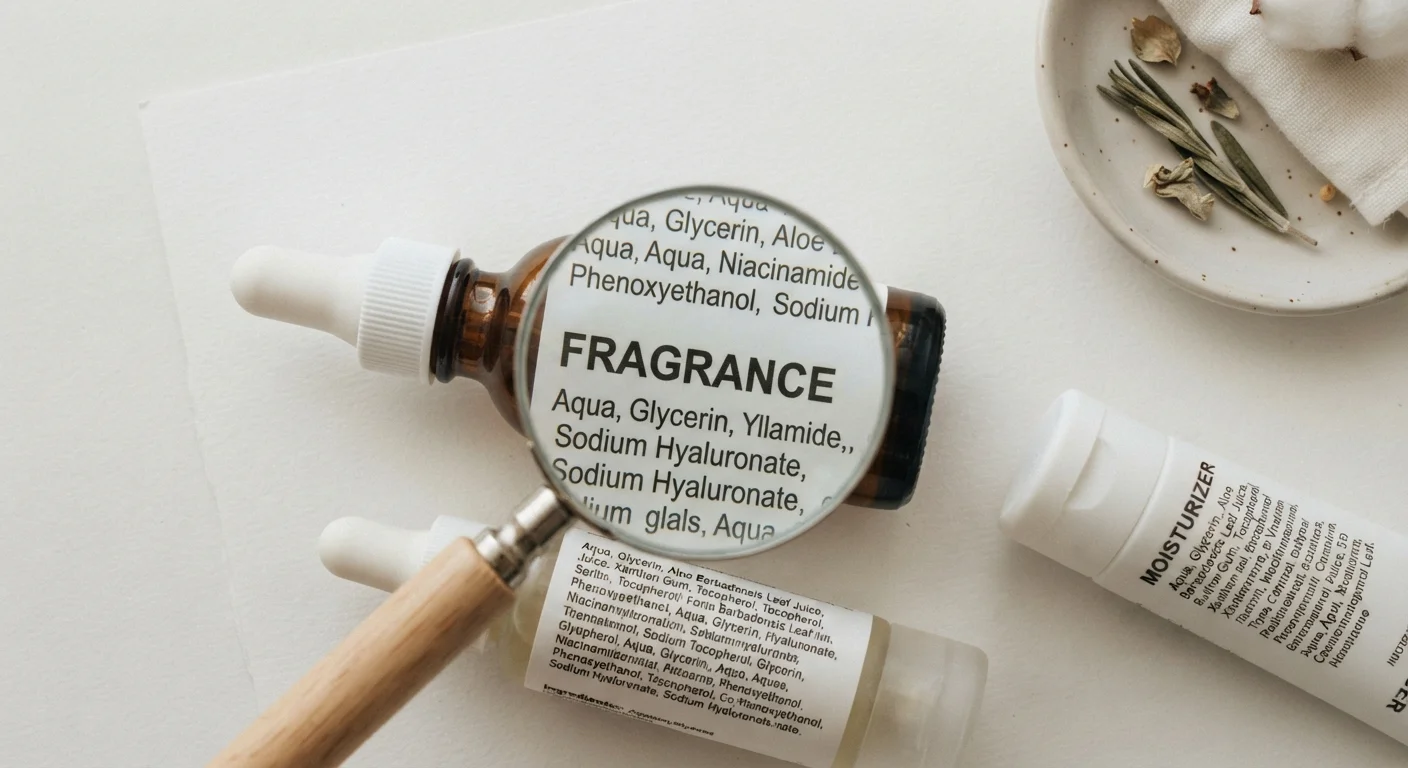
If you've ever flipped over a moisturizer and spotted the word 'fragrance' near the bottom of the ingredient list, you might have assumed it simply meant the product smells nice. The reality is more layered than that. Under current U.S. regulations, the word 'fragrance' - or its equivalent 'parfum' - is a legal placeholder for any proprietary scent formula, which can contain anywhere from a handful to well over a hundred individual chemical compounds.
This is a trade-secret exemption: cosmetics companies are not required to reveal the specific components of their fragrance blends. That single word can hide allergens, sensitizers, and synthetic chemicals that have no function in your skin - they're there purely for sensory experience.
Fragrance isn't always obvious, either. Sometimes individual fragrance chemicals are listed by their scientific names - linalool, limonene, citronellol, eugenol - because regulations in some markets require disclosure of the most common allergens individually. Learning to recognize these names gives you a fuller picture than relying on 'fragrance' alone. For a broader guide to reading beauty labels, see how beauty labels actually work.
Fragrance in Rinse-Off vs. Leave-On Products
Not all fragrance exposure carries the same risk. Rinse-off products like cleansers and shampoos are in contact with skin for a shorter time, which generally reduces absorption and irritation potential. Leave-on products - moisturizers, serums, eye creams, body lotions - maintain skin contact for hours, making fragrance in these formulas a more significant concern for sensitive skin types.
Why Sensitive Skin Reacts - and What That Looks Like
Fragrance is consistently ranked among the most frequent causes of allergic contact dermatitis in cosmetic products, according to dermatology research. Reactions can range from mild - a slight sting, temporary redness, or dryness - to more significant: persistent itching, hives, swelling, or a rash that spreads beyond where the product was applied.
Two distinct types of reactions are worth understanding. Irritant contact dermatitis is a direct, non-immune response: the skin barrier is overwhelmed by a chemical and becomes inflamed. Allergic contact dermatitis involves the immune system; once sensitized to a fragrance compound, even tiny exposures can trigger a disproportionate reaction. Sensitization can develop over time, meaning a product you've used for years could start causing problems.
People with eczema, rosacea, or a compromised skin barrier are at elevated risk. But reactions aren't limited to people with diagnosed conditions - anyone can develop fragrance sensitivity, and it can appear at any age.
~1 in 5
People with contact allergies react to fragrance
Fragrance is among the most prevalent contact allergens identified in patch-test studies across dermatology clinics, according to published research in the Journal of the American Academy of Dermatology.
26
Fragrance allergens flagged for EU label disclosure
The European Union requires individual labeling of 26 specific fragrance chemicals considered high-risk allergens - a standard more detailed than current U.S. FDA requirements.
100+
Compounds potentially hidden under 'fragrance'
Industry formulations can include dozens to over a hundred individual chemical components under a single 'fragrance' or 'parfum' label entry, per cosmetic chemistry literature.
Natural vs. Synthetic: Does It Matter?
A common misconception is that 'natural' fragrance is automatically safer than synthetic. In practice, the distinction matters less than many assume. Natural fragrance ingredients - including essential oils derived from lavender, bergamot, rose, ylang-ylang, and citrus - contain bioactive compounds that are well-established skin sensitizers.
Citrus-derived ingredients, for instance, contain limonene and linalool, both of which are on the EU's list of 26 fragrance allergens requiring individual label disclosure. Rose and jasmine extracts contain eugenol and geraniol, similarly flagged. Synthetic fragrance components can also be irritating, but the chemical complexity of many essential oils means natural options are not a guaranteed step down in risk.
This doesn't mean you need to panic about every botanical extract - context, concentration, and your individual skin history all factor in. What it does mean is that 'clean,' 'natural,' or 'plant-based' on a label isn't a shortcut for 'safe for sensitive skin.'
Check Ingredient Databases Before You Buy
Free tools like INCIDecoder and EWG's Skin Deep database let you search full ingredient lists and flag fragrance-related compounds - including those listed by their individual chemical names rather than the umbrella term 'fragrance.' Spending two minutes cross-referencing a new product before purchase can save significant skin frustration later.
Fragrance-Free vs. Unscented - and How to Use This When Shopping
These two terms sound interchangeable, but they describe very different things. Fragrance-free means no fragrance ingredients - synthetic or natural - were added. Unscented means the final product has no detectable smell, but this is sometimes achieved by adding a masking fragrance that neutralizes other odors without contributing a noticeable scent. That masking agent still counts as fragrance on the ingredient list.
For sensitive skin, fragrance-free is typically the more informative claim. It's also worth noting that neither term is strictly regulated by the FDA in the U.S., so reading the ingredient list directly remains the most reliable approach.
When building or simplifying a skincare routine, understanding what each product is actually doing - and what it contains - helps you make more informed choices. Our guide on what each skincare step is actually doing is a useful companion read. And when you're introducing anything new, patch testing and product cycling can help you catch irritation early before it becomes a larger problem.
This article is for informational purposes only and is not a substitute for advice from a qualified dermatologist or healthcare professional. If you experience a skin reaction, consult a licensed professional.