Why Your Skin Needs Different Things at Different Times
Your skin follows a circadian rhythm - a roughly 24-hour biological cycle that influences how it behaves throughout the day. During daylight hours, skin acts as a barrier, defending against UV radiation, pollution, and environmental stress. At night, it shifts into repair mode: cell turnover accelerates, collagen synthesis increases, and the skin barrier works to recover moisture it lost during the day.
This internal clock is well-documented in dermatological research, and it has a direct practical implication: the ingredients your skin can actually use at 10 PM are different from the ones it needs at 7 AM. Treating both routines as the same - or skipping one altogether - means leaving real performance on the table. See what each skincare step is actually doing to understand the purpose behind every product before you layer anything.
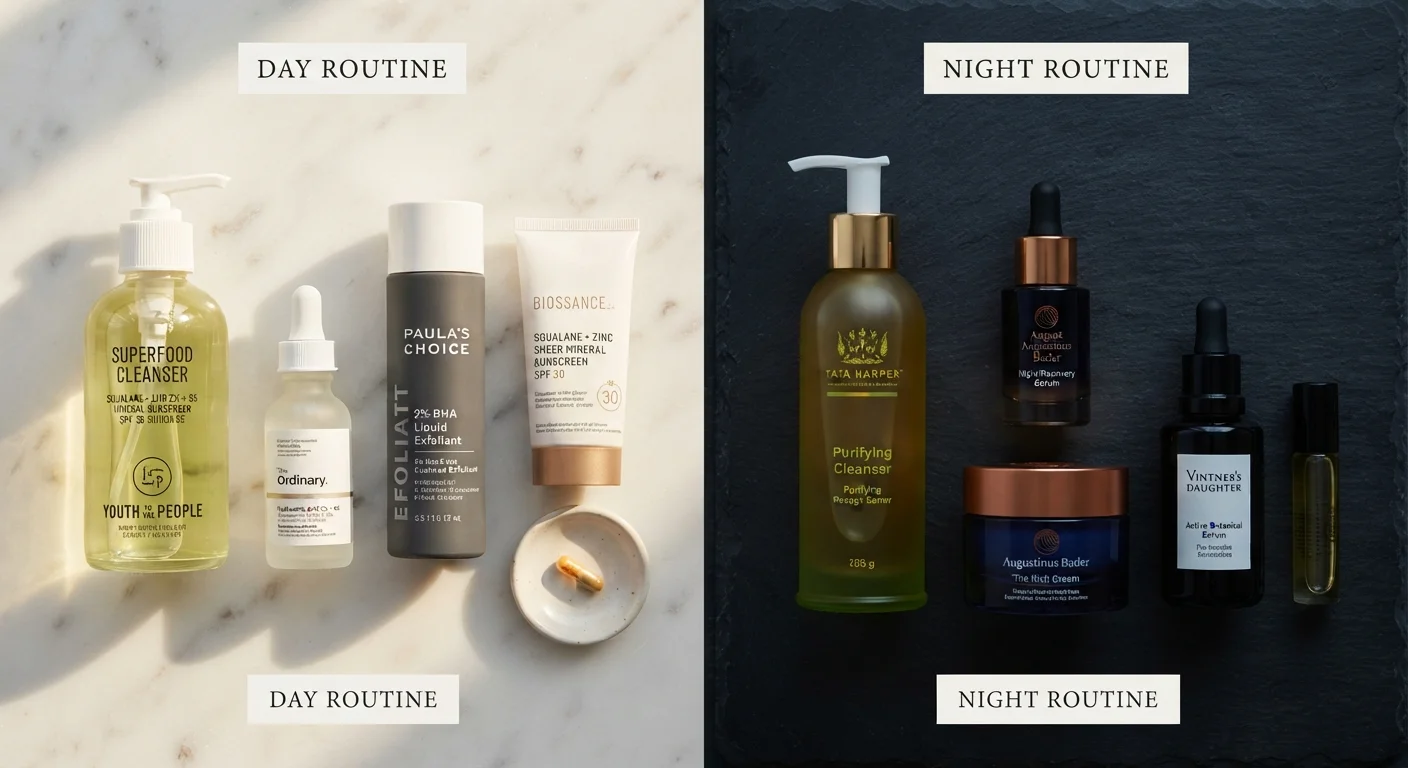
What Belongs in a Daytime Routine
The AM routine is your defense strategy. Its priorities are protection, antioxidant support, and lightweight hydration that won't interfere with makeup or feel heavy throughout the day.
- Cleanser: A gentle, low-lather formula removes overnight product residue without stripping. Many people with normal to dry skin do fine with water alone in the morning.
- Vitamin C serum: Applied before SPF, a stable vitamin C formula helps neutralize free radicals generated by UV and pollution exposure.
- Moisturizer: Lightweight gels or fluid lotions work well under SPF and keep the skin barrier supported.
- Broad-spectrum SPF 30 or higher: Non-negotiable. This is the single most evidence-backed step in any daytime routine. Without it, many nighttime actives - retinoids, AHAs, exfoliating acids - can cause photosensitivity and undo progress.
For a step-by-step walkthrough of morning routine sequencing, building a simple morning skincare routine from scratch covers all the essentials.
Keep Your Morning Routine Streamlined
A daytime routine doesn't need to be complicated to be effective. Cleanser, antioxidant serum, moisturizer, and SPF covers the core bases. Resist the urge to layer too many actives in the morning - saving the heavy-hitters for nighttime lets each product do its job without interference.
What Belongs in a Nighttime Routine
The PM routine is your repair strategy. Skin is more permeable at night, and without UV exposure to worry about, you can use ingredients that would cause sensitivity in sunlight.
- Double cleanse (if wearing SPF or makeup): An oil-based cleanser first, followed by a water-based cleanser, ensures actives applied next can absorb properly.
- Exfoliating acids (AHAs/BHAs): Glycolic acid, lactic acid, and salicylic acid work with your skin's natural nighttime cell turnover - but use them 2-3 nights per week at most to avoid barrier disruption.
- Retinoids: Vitamin A derivatives (retinol, tretinoin) are the most research-supported anti-aging ingredient class available. They degrade in sunlight and increase photosensitivity, making nighttime the only appropriate window. Start slowly - every third night is a reasonable approach for beginners.
- Richer moisturizer or facial oil: Thicker occlusives and emollients seal in treatment products and support overnight barrier repair.
Layering skincare products in the right order explains how sequence affects absorption - especially important when you're stacking actives at night.
| Daytime Routine | Nighttime Routine | |
|---|---|---|
| Primary goal | Protection from environmental stressors | Repair and cellular renewal |
| Cleanser type | Gentle, minimal-lather | Thorough; double cleanse if wearing SPF/makeup |
| Key actives | Vitamin C, niacinamide, peptides | Retinoids, AHAs, BHAs |
| Moisturizer weight | Lightweight gel or lotion | Richer cream or facial oil |
| SPF required | Yes - always | No |
| Exfoliation appropriate | Generally not recommended | Yes, 2-3 nights per week max |
| Retinoids appropriate | No - sun degrades and sensitizes | Yes - apply after cleansing |
Common Mistakes - and How to Avoid Them
Even well-intentioned routines go sideways with a few mix-ups:
- Using retinol in the morning: Sun exposure degrades retinol and can cause significant irritation. Always apply it at night and follow up with SPF the next morning.
- Skipping SPF on cloudy days: UVA rays - the ones linked to premature aging - penetrate cloud cover and glass. SPF belongs in the daytime routine every single day.
- Piling heavy occlusives on in the morning: Rich creams and facial oils applied before SPF can dilute the sunscreen film and make skin look greasy. Save the heavy moisturizer for your nighttime routine.
- Using strong exfoliants every night: More is not more with AHAs and BHAs. Over-exfoliation disrupts the skin barrier and can cause redness and sensitivity. Two to three nights per week is plenty for most people.
Your skin's needs also shift with seasons and climate - a seasonal skincare audit can help you recalibrate both routines when the weather changes significantly.
Never Skip SPF After Using Nighttime Actives
Retinoids, AHAs, and BHAs all increase your skin's sensitivity to UV radiation - sometimes for days after application. Skipping SPF the morning after using these ingredients can lead to irritation, redness, and hyperpigmentation. Make broad-spectrum SPF the last step of every morning routine, no exceptions.
This article is for general informational purposes only and does not constitute medical or dermatological advice. Consult a licensed dermatologist or healthcare professional if you have specific skin concerns, conditions, or reactions to skincare ingredients.