What Each Coverage Level Actually Includes
Understanding the difference between liability-only and full coverage starts with knowing what each term actually encompasses. For a deeper breakdown of individual coverage types, see our guide to what your car insurance policy actually covers.
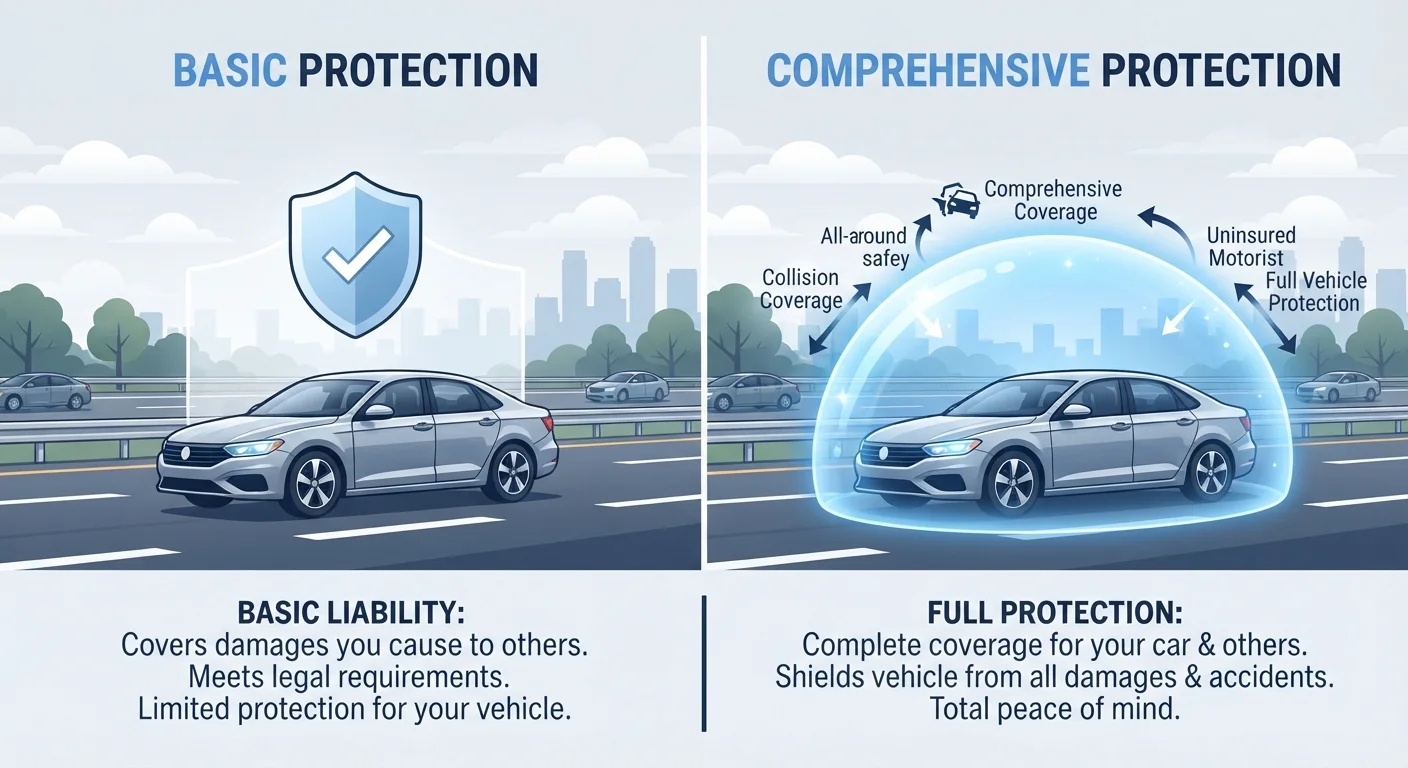
Liability coverage pays for bodily injury and property damage you cause to other people in an at-fault accident. It does not pay anything toward repairing or replacing your own vehicle. Every US state except New Hampshire requires drivers to carry at least a minimum level of liability insurance, though those minimums vary significantly by state.
Full coverage is not a single policy type - it's an industry shorthand for a combination of liability, collision, and comprehensive coverage. Collision pays to repair or replace your vehicle after an accident with another car or object, regardless of fault. Comprehensive covers non-collision events: theft, vandalism, weather damage, fire, and animal strikes. Together, these three layers give you protection on both sides of an accident.
| Criterion | Liability-Only | Full Coverage |
|---|---|---|
| Covers damage to others | Yes | Yes |
| Covers your vehicle after collision | No | Yes |
| Covers theft, weather, fire | No | Yes |
| Required by law | Yes (minimum level) | No (unless financed/leased) |
| Typical cost | Lower premium | Higher premium |
| Best vehicle age | Older, lower-value vehicles | Newer or high-value vehicles |
| Deductible applies | No | Yes (collision & comprehensive) |
The Financial Logic Behind Each Choice
The core financial question is straightforward: does the cost of adding collision and comprehensive coverage justify the benefit, given your vehicle's current value?
A commonly used rule of thumb is to evaluate whether your annual premium for comprehensive and collision exceeds 10% of your car's actual cash value. If it does, you may be paying more for the coverage than you could realistically recover in a claim - especially after your deductible is subtracted. Your deductible (the amount you pay out of pocket before insurance kicks in) plays a major role here: a higher deductible lowers your premium but increases your exposure in any individual claim.
~$700
Average annual cost of liability-only coverage
According to industry data compiled by the Insurance Information Institute, liability-only policies cost significantly less per year than full coverage packages for most US drivers.
~$1,700
Average annual full coverage premium (US)
The National Association of Insurance Commissioners has reported average full coverage premiums well above $1,500 annually, though costs vary widely by state, age, and driving history.
~77%
Share of insured US drivers carrying full coverage
Industry estimates suggest the majority of American drivers carry some form of full coverage, partly driven by lender requirements on financed vehicles.
For financed or leased vehicles, the decision is largely made for you. Lenders include full coverage requirements in the loan agreement to protect their asset. Dropping to liability-only on a financed car can trigger force-placed insurance - a costly, lender-chosen policy added to your loan - or even default.
Drivers who own older vehicles outright have the most flexibility. If a car's replacement value is modest and you have adequate savings to cover a loss, carrying only liability coverage is a legitimate and financially rational choice. See our guide to managing vehicle ownership costs for broader context on insurance as part of total ownership expenses.
Other Factors That Should Influence Your Decision
Vehicle value and loan status are the biggest factors, but they aren't the only ones worth considering.
- Where you park and drive: High-theft urban areas, regions prone to hail, flooding, or wildfires, and highways with heavy truck traffic all raise the likelihood that comprehensive or collision coverage pays off.
- Your driving record and risk profile: Drivers with a history of at-fault accidents statistically face greater exposure to collision claims. Insurers factor this into premiums - and it's worth factoring into your own coverage decision as well. Our overview of what affects your car insurance premium explains how these variables interact.
- How much you drive: High annual mileage increases accident exposure and can shift the math toward carrying broader coverage.
- Your financial cushion: Full coverage is partly a function of how much financial risk you can absorb without disruption. If replacing your vehicle tomorrow would cause real hardship, the added premium for full coverage may be worth it regardless of the car's age.
Gap Insurance: A Related Consideration
If you recently purchased a new or near-new vehicle with financing, your car's actual cash value can drop below your loan balance quickly - a situation known as being 'underwater.' In this case, even full coverage may not pay off your loan entirely after a total loss. Gap insurance is a separate, optional product that covers the difference between what your insurer pays and what you still owe. Ask your lender or insurer whether it's worth adding for your situation.
This article is for general informational purposes only and does not constitute insurance or financial advice. Coverage requirements, costs, and terms vary by state and insurer. Consult a licensed insurance professional for guidance specific to your situation.