
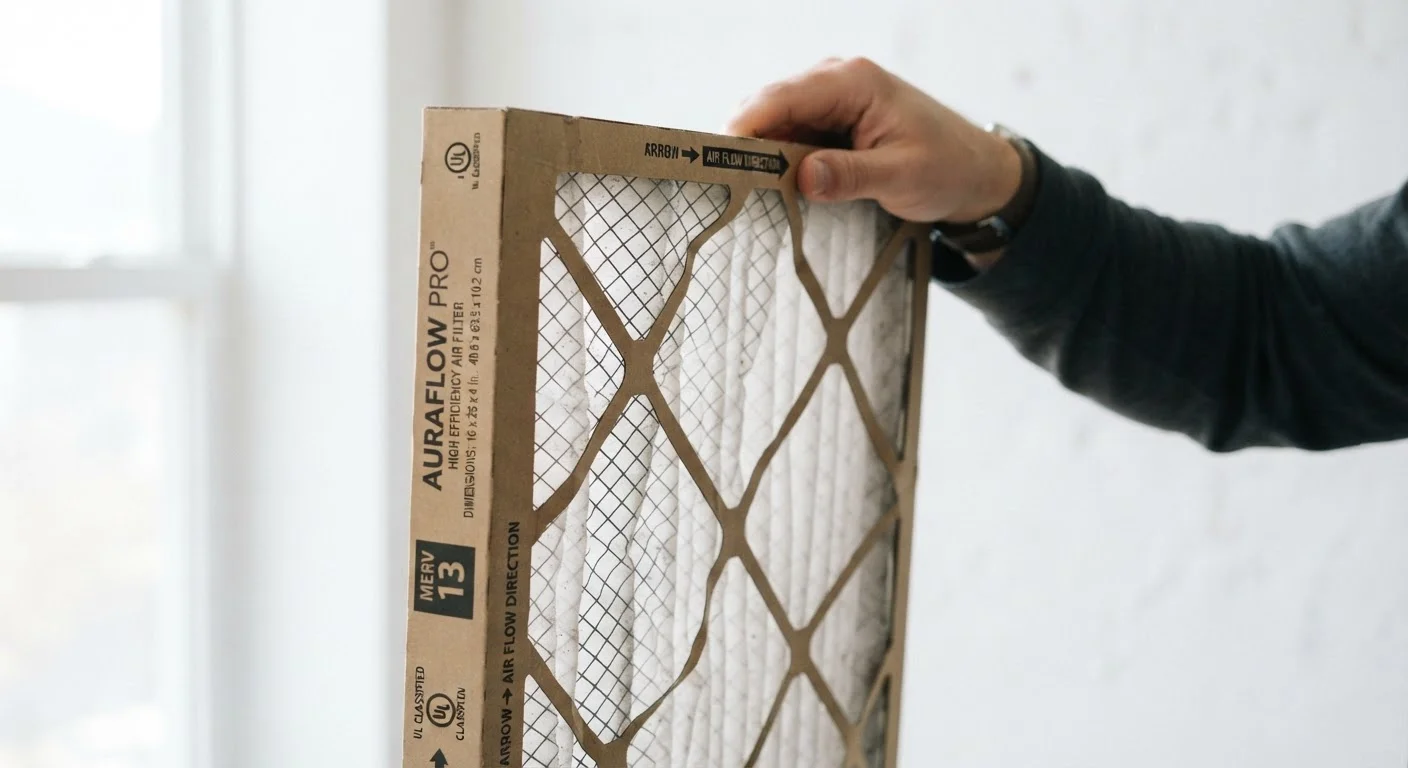
Three Rating Systems, One Confusing Label
Walk down the filter aisle at any home improvement store and you'll see a wall of numbers: MERV 11, MPR 1500, FPR 7. These aren't interchangeable - they come from three separate rating systems, and mixing them up is one of the most common mistakes homeowners make when buying filters.
MERV (Minimum Efficiency Reporting Value) is the industry-wide benchmark established by ASHRAE, an international engineering standards organization. It runs from 1 to 16 for residential and commercial use (up to 20 for specialized applications). Because it's standardized, MERV lets you compare filters from any manufacturer on equal footing - similar in concept to how a credit score gives lenders a standardized way to evaluate risk.
MPR (Micro-Particle Performance Rating) is a proprietary scale used by one major filter manufacturer. It ranges roughly from 300 to 2800 and focuses specifically on particles smaller than 1 micron in size.
FPR (Filter Performance Rating) is another proprietary scale used by a different manufacturer and found primarily at one major home improvement chain. It runs from 4 to 10.
Why You Can't Directly Compare MPR and FPR to MERV
Because MPR and FPR are proprietary scales, they use different testing protocols and particle size targets than MERV. Many filter packages now print an approximate MERV equivalent alongside the proprietary rating - look for it when comparing options across brands. When in doubt, MERV is your universal benchmark.
Because MPR and FPR are manufacturer-specific, their numbers can't be directly compared to each other or to MERV ratings. If you're evaluating multiple filter options, look for the MERV rating as your consistent reference point.
What the Numbers Actually Measure
All three systems measure roughly the same thing: what percentage of airborne particles a filter captures at a given size range. Particle sizes are measured in microns. For context, a human hair is about 70 microns in diameter; the particles that most affect air quality - like fine dust, pollen, pet dander, and mold spores - range from 0.3 to 10 microns.
0.3-10 µm
Size range of most air quality particles
Particles in this range - including pollen, mold spores, and fine dust - are the primary targets of residential HVAC filtration; standard MERV ratings are benchmarked against these sizes.
MERV 8-11
Recommended range for most homes
ASHRAE guidance and HVAC industry professionals generally consider this range appropriate for typical residential systems, balancing filtration efficiency with system airflow needs.
1-3 months
Typical filter replacement interval
The U.S. Department of Energy and HVAC manufacturers commonly recommend checking filters monthly and replacing standard 1-inch filters every one to three months depending on conditions.
Here's how MERV ratings break down in practical terms:
- MERV 1-4: Basic fiberglass filters. Capture large debris like carpet fibers and dust bunnies. Protect the equipment, not your lungs.
- MERV 5-8: Standard pleated filters. Capture mold spores, dust mite debris, and most pollen. Suitable for most homes.
- MERV 9-12: Higher-grade filters. Add capture of finer particles including pet dander, fine dust, and some smoke particles.
- MERV 13-16: Near-HEPA performance. Capture bacteria and very fine smoke. Typically used in hospitals; may exceed what residential blowers can handle.
Understanding these tiers works the same way as reading any other product specification - knowing which numbers genuinely matter for your use case separates useful information from marketing noise. See our guide to decoding product specifications for a broader framework on this skill.
Choosing the Right Filter for Your System
The temptation is to buy the highest-rated filter available. Resist it. A denser filter creates more airflow resistance - measured as static pressure - and your HVAC system's blower motor has limits. Exceeding those limits can reduce heating and cooling efficiency, cause the system to run longer cycles, and in some cases lead to premature motor failure.
Match the Filter to Your System First
Before upgrading your filter's MERV rating, check your HVAC system's owner's manual for the maximum recommended rating. If you can't find it, look up the model number online or ask an HVAC technician. Installing a filter your system can't support may cause more harm than running a lower-rated filter.
Practical guidelines for most households:
- Basic home, no pets, no allergies: MERV 8 is typically sufficient and easy on the system.
- Pets or mild allergies: MERV 10-11 adds meaningful filtration without dramatic airflow restriction in most systems.
- Asthma or significant allergy concerns: MERV 13 may be appropriate - but verify with your HVAC technician first, as not all residential systems can support it.
Check your system's owner's manual for its stated maximum MERV rating. If you've lost the manual, an HVAC technician can advise based on your system's blower specifications. Filter selection is one of those maintenance decisions that benefits from a brief professional check-in, not just a label scan.
Also worth knowing: filter ratings say nothing about odor or chemical filtration. If you're dealing with cooking smells, pet odors, or off-gassing from new materials, you'd need an activated carbon filter - a separate category entirely with its own evaluation criteria.
This article provides general home maintenance information. For guidance specific to your HVAC equipment, consult a licensed HVAC professional.