Why the Method You Choose Actually Matters
Most people who try to budget and stop don't fail because they picked the wrong numbers - they fail because the system they chose didn't fit how they actually live. A person who hates staring at screens won't stick with a spreadsheet. Someone who never carries cash won't thrive with a purely manual log. Before deciding on a format, it helps to understand what each approach is actually asking of you.
If you haven't yet taken stock of your spending patterns, that groundwork matters first. See our guide to tracking where your money goes before committing to any system. Once you have a rough picture of income and expenses, the method below that feels least like friction is usually the one worth trying.
Pen-and-Paper: Low Barrier, High Intentionality
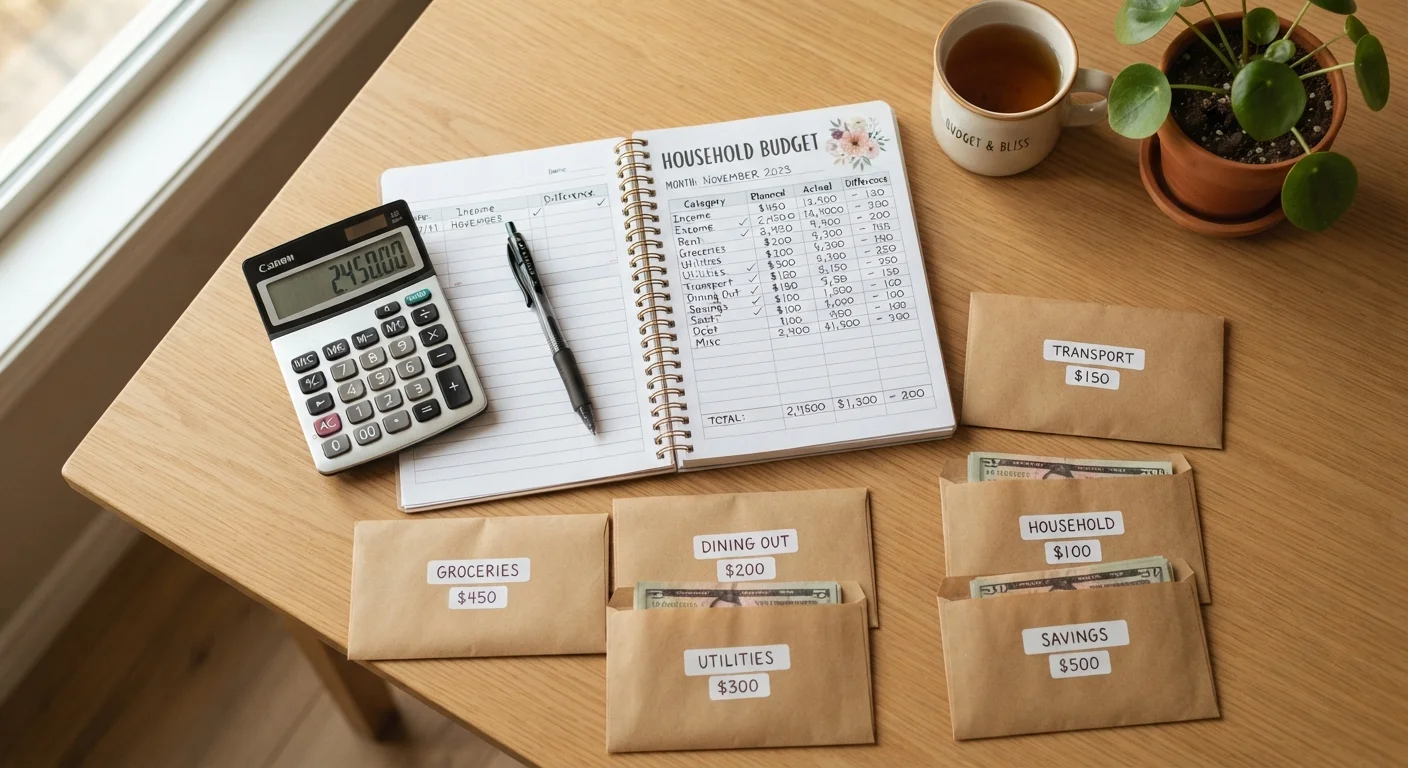
Writing down income and expenses by hand is the oldest budgeting method - and it still works. Research in learning and memory suggests that physically writing information reinforces recall more than typing it, which means the act of recording a purchase may itself make you more aware of your spending habits.
What it requires: A notebook, a pen, and a willingness to log transactions manually - ideally every day or every few days. A simple layout covers the basics: income at the top, fixed expenses (like rent and insurance) listed next, then variable categories like groceries and dining. You can use fixed, variable, and discretionary spending categories as your column structure.
Where it falls short: There's no automation. If you forget to log a transaction or lose your notebook, your picture of spending becomes incomplete. Running monthly totals means doing arithmetic by hand, and there's no easy way to spot trends over several months without flipping back through pages.
Start Simple to Build the Habit
If you've never formally tracked spending before, a single notebook page with five or six categories is enough to start. Resist the urge to build an elaborate system before you've tested whether you'll actually update it weekly. A simple system you use consistently will outperform a complex one you abandon after two weeks. You can always add detail once the habit is established.
Spreadsheets: Custom Control at No Cost
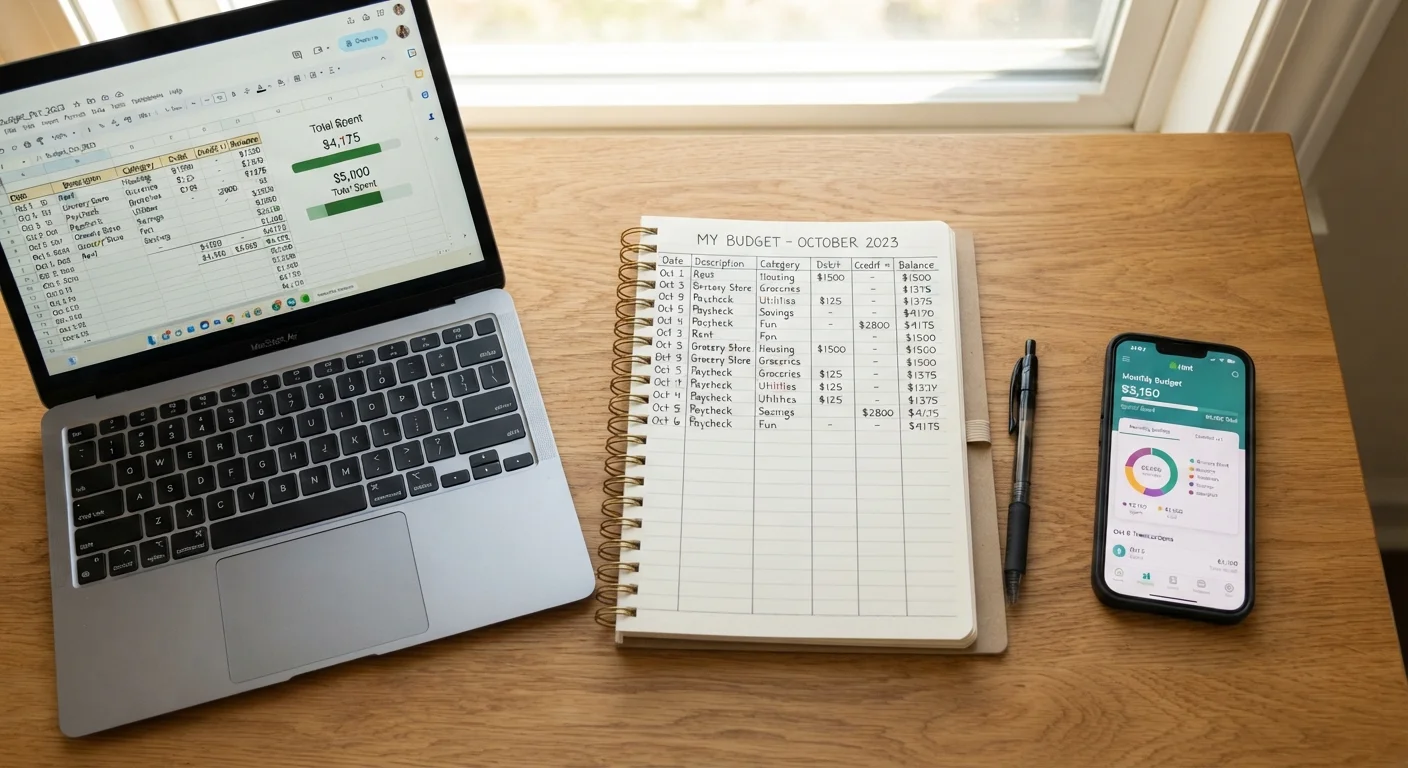
A spreadsheet - whether in a free tool like Google Sheets or a paid option - sits between pen-and-paper and a dedicated app. You still enter most data manually, but formulas handle the math automatically, and you can build visuals like charts to see spending by category over time.
What it requires: Basic comfort with rows, columns, and simple formulas like SUM(). Many people start from a template rather than building from scratch. A good spreadsheet budget includes columns for planned amounts and actual amounts side by side - that gap between intention and reality is often where the most useful financial insight lives.
Where it falls short: Spreadsheets don't connect to your bank accounts, so data entry is still manual. They also require some discipline to maintain: a spreadsheet that's two weeks out of date is less useful than no spreadsheet at all. For those with an irregular paycheck, adapting a spreadsheet to variable income takes extra setup - see budgeting approaches for irregular income for strategies that translate well to this format.
| Pen-and-Paper | Spreadsheet | Budgeting App | |
|---|---|---|---|
| Setup effort | Very low - just a notebook | Moderate - build or adapt template | Low - guided onboarding |
| Ongoing time commitment | High - fully manual logging | Medium - manual entry, auto math | Low - mostly automated |
| Cost | Near zero | Free to low cost | Often free or subscription |
| Customization | Unlimited, informal | High, structured | Moderate, within app limits |
| Data privacy risk | None - fully offline | Low - stored locally or in cloud | Higher - linked to bank accounts |
| Best for spotting trends | Weak - manual review | Good - with charts and history | Strong - automatic summaries |
| Learning curve | Minimal | Low to moderate | Low |
Budgeting Apps: Automation and Real-Time Visibility
Budgeting apps typically connect to your bank accounts and credit cards, pulling in transactions automatically and categorizing them. This removes the manual logging step and lets you see your spending across all accounts in one place.
What it requires: Willingness to link financial accounts to a third-party service. Most apps use read-only connections through bank-level encryption, but sharing account credentials or linking via open-banking protocols does carry some data-privacy considerations worth understanding before signing up.
Where it falls short: Automatic categorization isn't always accurate - a charge at a restaurant that doubles as a grocery store might be miscategorized, requiring manual correction. Some apps charge a monthly or annual subscription fee. And because the app handles the heavy lifting, some users find they're less engaged with their numbers than they would be logging manually.
Apps work particularly well alongside a defined budgeting framework. If you're weighing which structure to follow, comparing zero-based budgeting with the 50/30/20 rule can help you choose a method your app can then track.
~33%
Americans with a detailed household budget
Gallup polling has consistently found that fewer than half of American adults maintain a detailed household budget, suggesting most people are budgeting informally or not at all.
~80%
App users who cite convenience as top benefit
Surveys of personal finance app users frequently list automation and real-time alerts as the primary reasons they prefer apps over manual methods.
Getting Started - Whichever Path You Take
Switching methods mid-budget is entirely normal. Many people begin with pen-and-paper to build awareness, then migrate to a spreadsheet once they understand their spending categories, and eventually explore an app once they want less manual work. Others move in the opposite direction after feeling disconnected from their numbers in an app.
Use the monthly budget setup checklist to make sure you're capturing all the right inputs - income sources, fixed obligations, and discretionary categories - regardless of format. If your goal is to build savings alongside your budget, practical saving and goals concepts can help frame what you're working toward.
The most important factor isn't which tool you use. It's whether you'll actually use it consistently - and that's a question only you can answer.
This article is for general informational purposes only and does not constitute personalized financial advice. Consider consulting a qualified financial professional for guidance specific to your circumstances.