
Why a Checklist Approach Works for Budgeting
Most people who abandon budgeting don't fail because they lack discipline - they fail because they started without a complete picture. A forgotten annual car registration fee, an underestimated grocery bill, or a streaming subscription that slipped through the cracks can throw off even a well-intentioned plan. See our look at expenses most first-time budgeters leave out for a fuller sense of the gaps that tend to appear.
This checklist walks through every stage of the setup process - from gathering the raw numbers to choosing how you'll track spending day to day. Work through each group in order. You don't need special software or financial expertise; you need a reliable process.
If you've never recorded your spending at all, it's worth spending a week or two tracking where your money goes before you try to control it - that baseline makes the budget-building step significantly more accurate.
Gather Your Income Information
List All Fixed Monthly Expenses
Estimate Variable and Irregular Expenses
Assign a Savings or Goals Amount
Balance the Numbers
Choose a Tracking Method
Schedule Your Monthly Review
Tools You'll Need
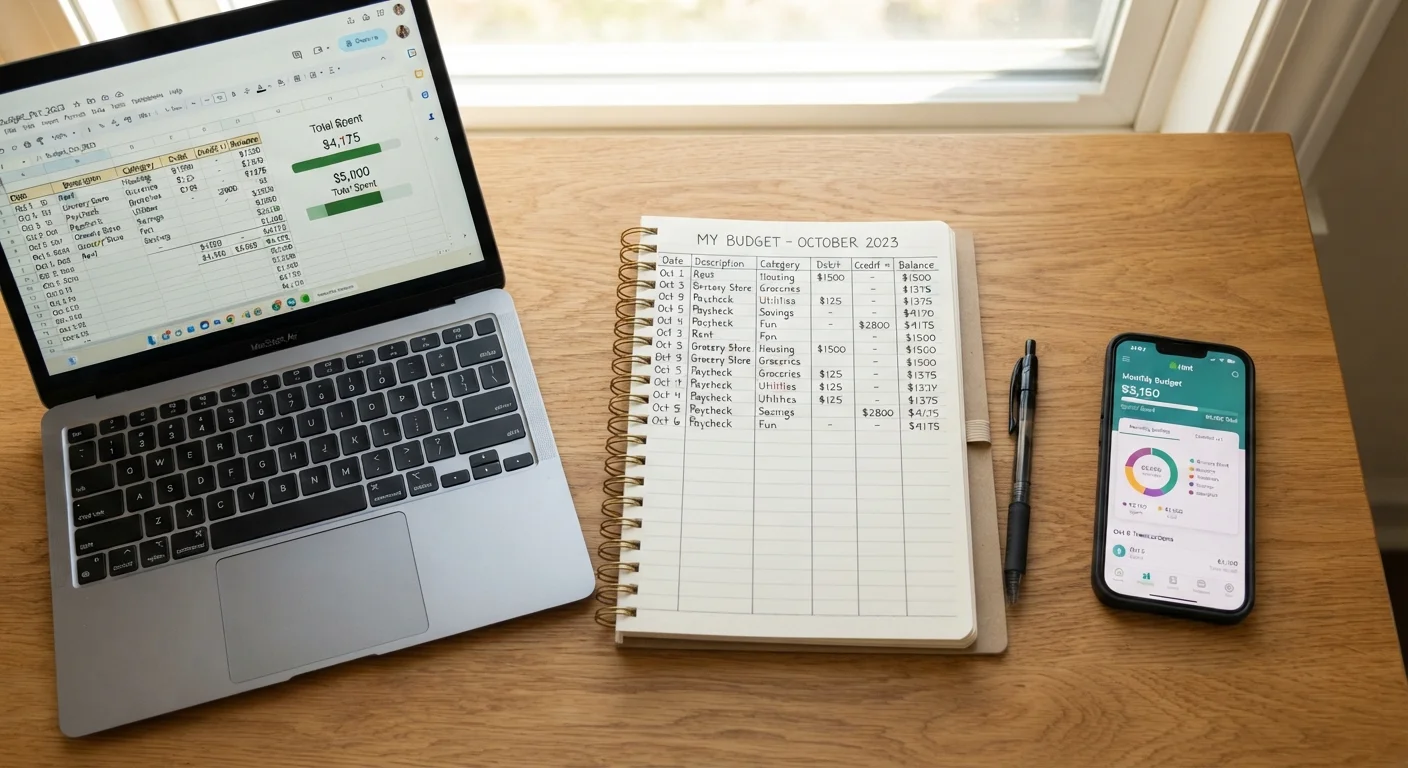
The right tool is the one you'll use consistently. If a smartphone app feels like too much friction, a printed spreadsheet works just as well. Compare the trade-offs of going analog, using a spreadsheet, or relying on an app to find the fit that suits how you actually live.
Bank and credit card statements (last 2-3 months)
Used to identify actual spending patterns and uncover forgotten subscriptions or irregular expenses.
Pay stubs or income records
Provides the accurate net income figure that forms the foundation of the budget.
Spreadsheet (e.g., Google Sheets or Excel)
Allows you to lay out income and expense categories side by side and do simple arithmetic.
Notebook and pen
A straightforward analog option for drafting your budget layout before committing to a digital format.
Budgeting app
Automates transaction categorization and tracks spending against your budget in real time.
Calendar or reminder app
Used to schedule your monthly review date and flag upcoming irregular expense due dates.
Common Pitfalls to Avoid at Setup
The setup phase is where most budgets quietly set themselves up to fail. Two patterns appear repeatedly.
Using Gross Income Instead of Net
A very common mistake is building a budget around your gross salary - the number before taxes, health insurance premiums, and retirement contributions are deducted. Your budget should be based on the amount that actually lands in your bank account. Using gross income will make your budget appear balanced when it isn't, and you'll run short every month without a clear reason why.
Forgetting Annual and Irregular Expenses
Expenses that don't bill every month are easy to exclude and among the most frequent reasons new budgets break down. Car insurance paid twice yearly, holiday spending, medical cost-sharing, and annual software renewals all represent real costs. Divide each by 12 and include them as monthly reserve amounts so they don't arrive as surprises.
Income variability is another common challenge. Freelancers, gig workers, and tipped employees often struggle to apply standard monthly budgeting approaches. If your paychecks aren't predictable, these approaches for budgeting on an irregular income are worth reviewing before you finalize your numbers.
If you're building a budget with a partner, combining two incomes and two sets of spending habits adds another layer of complexity. Budgeting as a couple changes the math in ways that go beyond simply adding incomes together.
A Budget Is a Plan, Not a Punishment
A monthly budget is a descriptive tool - it helps you understand where your money is going and make intentional choices. It doesn't require perfection in any given month. If your spending doesn't match your plan, that information is useful data, not a failure. Adjust the plan to reflect reality, and keep going.
After Setup: Keeping the Budget Alive
A budget you built and never looked at again won't help you. The final group of checklist items focuses on what happens after the initial setup - specifically, scheduling a monthly review and knowing what to adjust when the numbers don't match reality.
If you're curious about how to structure your spending across categories, the 50/30/20 rule is one widely discussed framework that allocates income across needs, wants, and savings. It's not the only approach, but it can provide useful guardrails. For broader saving concepts, the Saving & Goals hub covers practical strategies for building toward short- and long-term targets.
Most first budgets fall apart in month two - not because the person gave up, but because the plan wasn't built to handle real-life friction. Understanding those patterns before they happen is one of the most practical things you can do.
This article is for general informational and educational purposes only and does not constitute personalized financial, tax, or legal advice. For decisions specific to your financial situation, consider consulting a qualified financial professional.