What a Credit Report Actually Contains
A credit report is a structured record of your borrowing and repayment history, compiled by the three major consumer reporting agencies - Equifax, Experian, and TransUnion. While each agency may hold slightly different data depending on which lenders report to them, every standard report is organized around the same core sections. Knowing what sits in each section - and what lenders look for there - helps you read your own report with real comprehension rather than confusion.
It's worth noting upfront that a credit report is not the same as a credit score. The report is the raw data; the score is a numerical summary derived from it. For a deeper look at how those two things differ, see how credit reports and credit scores differ.
| Number of major credit bureaus | 3 (Equifax, Experian, TransUnion) (Consumer Financial Protection Bureau) |
| How long negative items typically remain | Up to 7 years (most items); up to 10 years (Chapter 7 bankruptcy) (Fair Credit Reporting Act (FCRA)) |
| Free report access frequency | At least once per year per bureau via AnnualCreditReport.com (FCRA, as amended) |
| Dispute resolution timeframe | Generally 30 days for bureau investigation (FCRA standard timeline) |
| Sections in a standard credit report | 4 primary sections: personal info, account history, public records, inquiries |
Personal Information and Identifying Data
The top of every credit report contains identifying information: your full name (including any variations or former names), current and previous addresses, date of birth, Social Security number (partially masked), and employment history. This section exists for identity verification, not creditworthiness evaluation. Lenders use it to confirm they are looking at the right person's file.
Errors here - a misspelled name, an address you never lived at, or an unfamiliar Social Security number - can signal a data-entry mistake or, more seriously, a sign of mixed files or identity theft. You have the right to dispute inaccuracies with the reporting agency directly.
Account History: The Heaviest Section
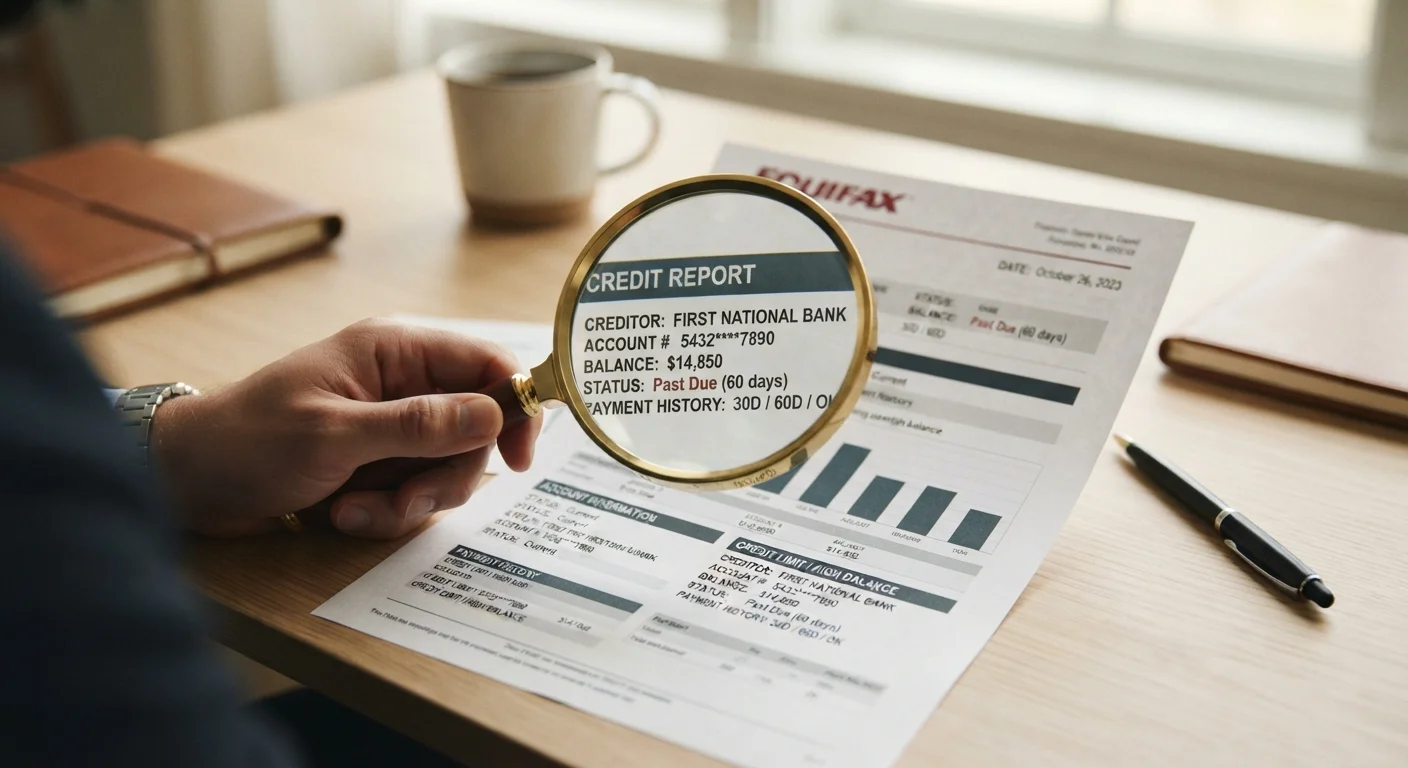
Account history, sometimes called the "tradeline" section, is typically the longest and most consequential part of a credit report. Each account you've held - credit cards, auto loans, student loans, mortgages, personal loans - appears here as its own entry. For each tradeline, lenders can see:
- Account type and creditor name
- Date the account was opened
- Credit limit or original loan amount
- Current balance
- Payment history - typically shown month by month, indicating whether payments were made on time, 30 days late, 60 days late, 90+ days late, or charged off
- Account status - open, closed, in collections, settled, etc.
Payment history is generally the single most influential factor in credit scoring models. A consistent record of on-time payments signals reliability; a pattern of late payments, especially recent ones, raises concern. The relationship between your balances and credit limits - your credit utilization ratio - is also visible here and weighs heavily on your score.
Tradeline
A term used in the credit industry to describe a single credit account on your credit report. Each loan, credit card, or line of credit you hold appears as its own tradeline with its own status and payment history.
Charge-off
When a creditor determines a debt is unlikely to be collected and writes it off as a loss, typically after 180 days of non-payment. A charge-off is reported to credit bureaus and is a serious negative mark, even if the debt is later sold to a collector.
Credit utilization
The ratio of your current revolving credit balances to your total revolving credit limits, expressed as a percentage. High utilization rates are generally viewed negatively by lenders and scoring models.
Hard inquiry
A credit file access triggered by a formal application for new credit. Hard inquiries are visible to lenders and may slightly reduce your credit score for a period of time.
Consumer reporting agency
A company, such as Equifax, Experian, or TransUnion, that collects and maintains consumer credit information and provides credit reports to authorized requestors.
Public Records and Collections
This section captures negative financial events that have moved beyond the lender relationship. Historically it included bankruptcies, civil judgments, and tax liens, though the major bureaus removed most civil judgment and tax lien data from consumer reports in recent years. Bankruptcies remain and can stay on a report for seven to ten years depending on the chapter filed.
Collection accounts - debts that a creditor transferred or sold to a collection agency after a period of non-payment - also appear here or within the tradeline section. Even a single collection account is a red flag for lenders, as it indicates a debt that went unresolved long enough to escalate.
Your Right to Dispute Errors
Under the Fair Credit Reporting Act (FCRA), consumers have the right to dispute inaccurate or incomplete information on their credit reports. Each of the three major bureaus has an online, mail, and phone dispute process. Once a dispute is filed, the bureau generally has 30 days to investigate and respond. If an item cannot be verified, it must be corrected or removed.
Inquiries: Hard vs. Soft
Every time someone accesses your credit file, that access is logged. The inquiry section is split into two categories. Hard inquiries occur when you apply for new credit - a mortgage, auto loan, or credit card - and the lender pulls your file to make a lending decision. These are visible to other lenders and can modestly reduce your score for a period. Soft inquiries include background checks by employers, pre-approval checks by lenders, and your own credit pulls; they don't affect your score and aren't visible to creditors reviewing your file.
Multiple hard inquiries in a short window can suggest to lenders that you are actively seeking new credit, which some scoring models treat as a risk indicator. Rate-shopping for a single loan type - like a mortgage or auto loan - is generally treated more leniently by scoring algorithms, which often group inquiries of the same type made within a short timeframe. For a full explanation, see the difference between hard and soft inquiries.
Understanding everything in your report is also the foundation for understanding your credit score. See what a credit score actually measures for how this data gets translated into a number.
This article is for general informational purposes only and does not constitute financial or legal advice. For questions specific to your credit situation, consult a qualified financial professional or contact the relevant consumer reporting agency directly.