How Compounding Actually Works
The core mechanic of compound interest is simple: when interest is added to your balance, that new, larger balance becomes the basis for calculating your next interest payment. You earn interest on interest. Over short stretches, this looks nearly identical to simple interest. Over years and decades, the difference becomes striking.
Consider a $5,000 deposit earning 4% annually. With simple interest, you'd earn $200 per year - the same amount every single year. With annual compounding, you'd earn $200 in year one, but in year two your balance is $5,200, so you'd earn $208. By year ten, your annual interest would exceed $280 on the original $5,000 - despite depositing nothing extra.
The APY listed on savings accounts reflects compounding. It's a more accurate picture of what you'll actually earn over a year than the nominal rate alone, and it's the number worth comparing across accounts. For a closer look at how different account types apply these rates, see our overview of savings vehicles.
~$16,300
Value of $10,000 after 15 years at 3.5% APY
Illustrates compound growth on a single deposit with no additional contributions, compounded annually.
72
"Rule of 72": years to double your money
Divide 72 by your interest rate to estimate how many years it takes your balance to double - a widely used rule of thumb in personal finance education.
Daily
Most common compounding frequency in U.S. savings accounts
Many federally insured savings accounts compound interest daily and credit it monthly, according to standard banking disclosures.
Why Starting Early Matters More Than Starting Big
Time is the most powerful variable in the compounding equation - more so than the interest rate itself in many scenarios. A person who saves $3,000 per year from age 25 to 35 and then stops contributing will often end up with more at retirement than someone who saves the same $3,000 per year from age 35 to 65, assuming identical returns. The earlier saver's money simply has more years to compound.
This is why financial educators frequently describe compounding as "earning money while you sleep." Each year your money remains invested or saved, the snowball gets larger - and a larger snowball picks up more snow with each roll.
“Compound interest is the eighth wonder of the world. He who understands it, earns it; he who doesn't, pays it.”
— Widely attributed to Albert Einstein, Often cited in personal finance education as a memorable illustration of compounding's power (attribution unverified by historians)
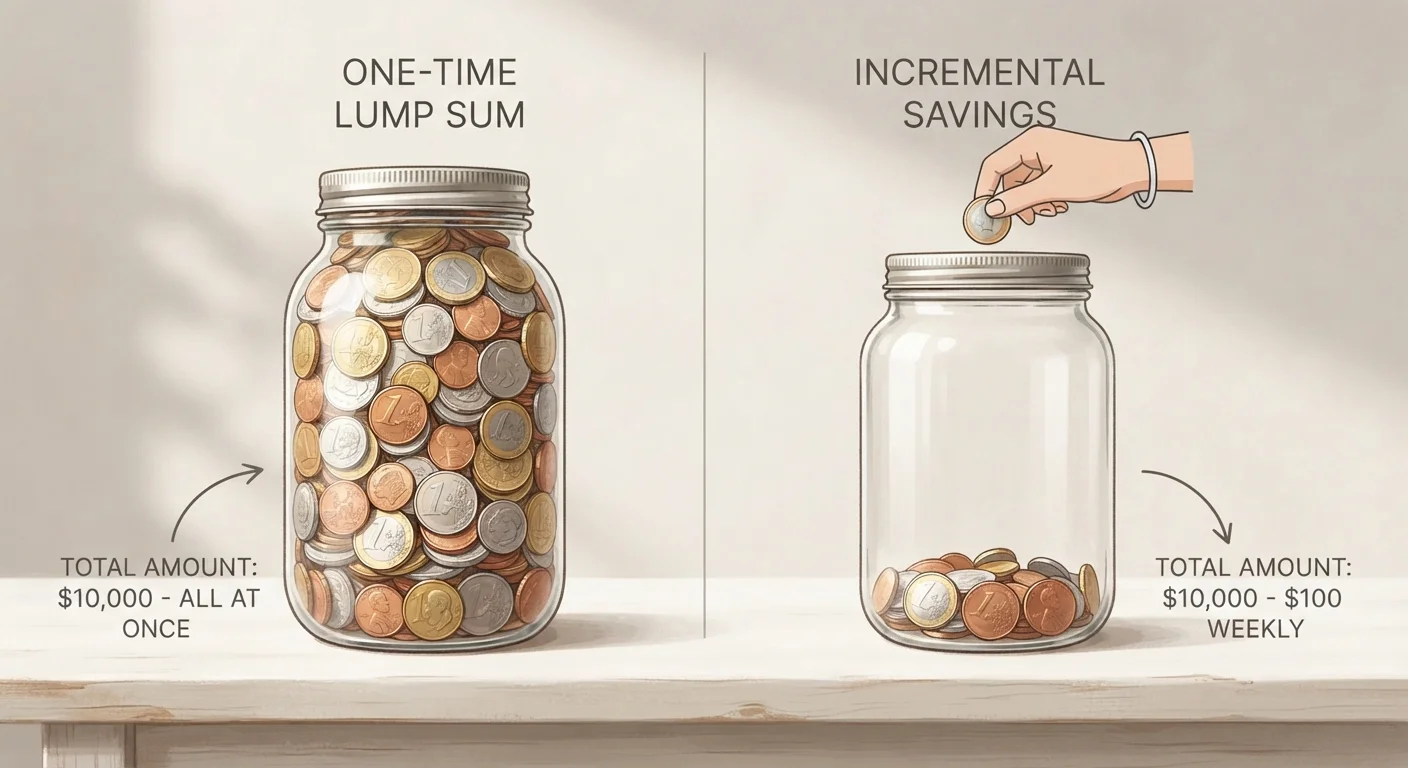
That doesn't mean late starters should give up. Increasing contributions and finding accounts with competitive rates can partially compensate for a shorter runway. If you're weighing lump-sum deposits against regular smaller contributions, the comparison of lump-sum vs. incremental saving explores the tradeoffs in detail.
The Role of Rate and Frequency
Two other factors shape how quickly compounding works: the interest rate and how often compounding occurs. A higher rate accelerates growth significantly - the difference between 2% and 5% compounded over 30 years is not 2.5x the result; it's far more, because a higher rate compounds on an ever-larger base.
Compounding frequency - daily, monthly, or annually - also matters, though its effect is subtler. Daily compounding yields slightly more than monthly, which yields slightly more than annual. The gap is small in any given year but compounds over time alongside everything else.
Look at APY, Not Just the Rate
When comparing savings accounts, focus on the Annual Percentage Yield (APY) rather than the stated interest rate. APY already accounts for compounding frequency, making it a true apples-to-apples comparison across accounts with different compounding schedules.
One way to take advantage of higher rates is to explore accounts specifically structured for yield. Our guide to high-yield vs. traditional savings accounts explains how the two differ and what to weigh when evaluating options.
What Compounding Looks Like for Different Goals
Compounding has a different practical meaning depending on your savings horizon. For short- vs. long-term savings goals, the mechanics are the same - but the stakes and strategy differ considerably.
For short-term goals (one to three years), compounding adds a modest but real boost. You won't see exponential growth in that window, but a competitive APY still earns more than letting cash sit idle. For long-term goals - retirement, education, or generational wealth - compounding is the central mechanism, not a side benefit. The timeline transforms it from a small advantage into a fundamental force.
One practical move that supports compounding over time is automation. When contributions arrive regularly and immediately start earning interest, you remove the gap between earning money and putting it to work. The guide to automating your savings covers how to structure that process and what to watch for.
This article is for general informational and educational purposes only and does not constitute personalized financial advice. Consult a qualified financial professional for guidance specific to your situation.