
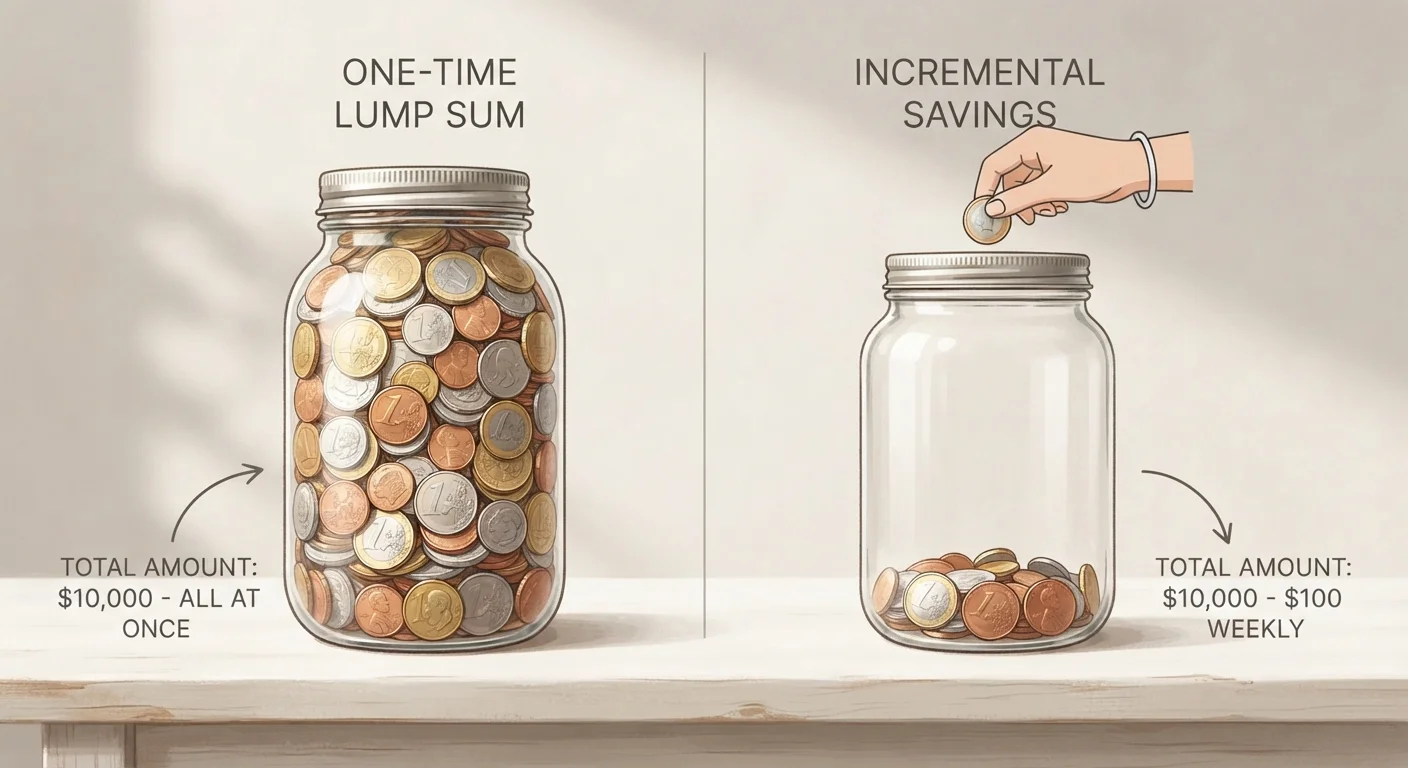
What Each Approach Actually Means
Lump-sum saving means depositing a large amount of money into a savings account - or other savings vehicle - in a single transaction. This often happens after a tax refund, year-end bonus, inheritance, or the sale of an asset. The entire sum begins earning interest (or otherwise working) from day one.
Incremental contributions - sometimes called periodic or systematic saving - involve setting aside smaller, regular amounts over time. Examples include automatically transferring $200 each payday into a savings account, or contributing a fixed percentage of each paycheck. This approach is closely related to the pay-yourself-first principle, which treats saving as a non-negotiable expense rather than an afterthought.
Both methods result in accumulated savings - they differ in timing, cash flow impact, and how much behavioral consistency they require.
The Case for Lump-Sum Saving
The core mathematical argument for lump-sum saving is straightforward: money deposited earlier has more time to earn interest. In an account with compound interest, a larger principal working from the start produces more growth than the same total amount deposited in installments over time. This advantage grows more significant the longer the saving horizon and the higher the interest rate.
Lump-sum saving also reduces the risk of spending money that was earmarked for savings. Once the deposit is made, the temptation to redirect funds elsewhere is removed. For people whose income arrives in unpredictable bursts - freelancers, commission earners, seasonal workers - depositing income promptly when it arrives can be more practical than trying to maintain a regular contribution schedule.
Consider Where Your Money Is Held
Whether you save in a lump sum or incrementally, the account you choose affects how much your savings grow. A high-yield savings account typically offers a higher annual percentage yield (APY) than a standard savings account, which can make a meaningful difference over time regardless of how contributions are structured. Compare account types before deciding where to park your savings.
That said, lump-sum saving requires having a substantial sum available at a single point in time - something many people's budgets don't naturally allow. It also means accepting reduced liquidity if the money is moved into an account with restrictions or penalties for early withdrawal.
The Case for Incremental Contributions
Incremental contributions fit naturally with how most Americans are paid - on a weekly, biweekly, or monthly basis. Saving a portion of each paycheck builds a habit, and automated transfers reduce the likelihood that the money gets spent before it's saved. Research in behavioral economics consistently shows that automation reduces friction and improves follow-through on financial intentions.
Regular contributions also smooth out volatility in cash flow. Rather than needing a large available balance, a person can work toward a goal progressively. This is especially relevant when building a first savings plan - the structure itself teaches the habit of saving, which compounds in value over time.
| Lump-Sum Saving | Incremental Contributions | |
|---|---|---|
| Best income fit | Irregular or windfall income | Regular salary or wages |
| Interest advantage | Higher - full principal earns from day one | Lower - later deposits earn less over time |
| Behavioral discipline required | High - must resist spending before depositing | Lower - automation reduces friction |
| Cash flow flexibility | Lower - large sum committed at once | Higher - smaller amounts spread over time |
| Accessibility for beginners | Harder - requires surplus funds available | Easier - works on any budget size |
| Habit-building value | Minimal - one-time action | High - reinforces regular saving behavior |
Incremental saving does carry one key trade-off: money contributed later in a saving period earns less interest than money contributed early. Over short timeframes this difference may be negligible, but over years the gap can become meaningful.
How Income Pattern Shapes the Decision
Income type is one of the most practical lenses for thinking about this choice. Salaried employees with predictable biweekly paychecks are well-suited to automated incremental contributions - systems like payroll direct deposit can route a set amount straight to savings without any manual action. The behavioral and logistical structures that support this kind of saving are well-documented and relatively easy to set up.
By contrast, people with variable income - gig workers, freelancers, small business owners - may find lump-sum saving more realistic. When income arrives, depositing a fixed percentage immediately can be more effective than relying on a calendar-based schedule that may not align with actual cash flow.
Goal timeline also matters. For longer-horizon goals like saving for a home down payment, incremental contributions over several years can accumulate substantially. Shorter-term goals may benefit from the immediacy of a lump-sum deposit whenever funds are available. See our overview of short-term vs. long-term savings goals for more context on how the timeline changes the strategy.
Don't Let 'Saving Later' Become Never
A common pitfall with lump-sum thinking is waiting for the 'right' large amount before starting to save at all. If a windfall doesn't materialize, months or years can pass without any progress toward a goal. Starting small with incremental contributions - even modest ones - keeps momentum going and prevents indefinite delay.
This article is for general informational purposes only and does not constitute personalised financial advice. Readers should consult a qualified financial professional regarding decisions specific to their circumstances.