
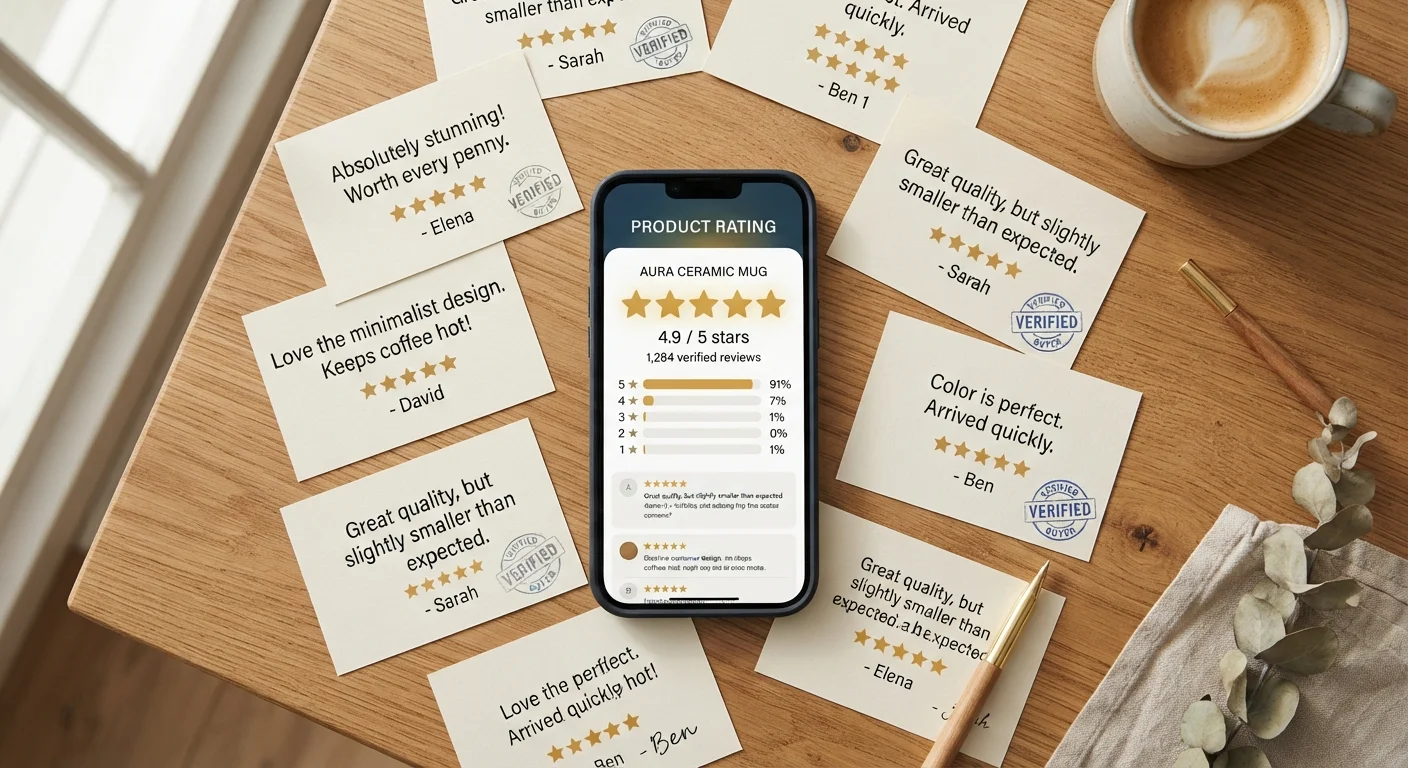
Why Star Ratings Are Structurally Incomplete
The five-star system is one of the most widely used - and most widely misread - signals in online shopping. Its appeal is understandable: it compresses thousands of opinions into a single, scannable number. But that compression is precisely where the problem starts.
Averages are blunt instruments. They tell you what happened in aggregate, not what is likely to happen for you, given your specific use case, preferences, and expectations. A kitchen tool rated 4.6 stars by professional cooks may frustrate a casual home baker who expected different performance. A travel bag praised for weekend trips may disappoint someone packing for two weeks abroad.
Ratings also carry no context about who left them, when, or under what conditions. Understanding these structural gaps is what separates a confident, informed purchase from a gamble dressed up as data.
Myth
A 4.5-star rating means the product is excellent for nearly everyone who buys it.
Fact
An average score conceals a wide distribution of experiences - some buyers may have rated it 1 star while others gave it 5, producing the same middle figure.
Star ratings are arithmetic averages. A product with 60% five-star reviews and 30% one-star reviews can still display 4.2 stars. The average obscures polarization. Shoppers who look only at the headline number miss the underlying spread entirely.
Check the rating histogram - a bar chart showing how reviews are distributed across each star tier - before drawing any conclusions. A tight cluster near the top signals genuine consensus; a spread across all five tiers signals a product that works well for some and poorly for others.
Myth
More reviews always means a more reliable rating.
Fact
High review volume reduces statistical noise, but it does not protect against systematic bias - such as incentivized reviews, review gating, or demographic skew.
A product with 10,000 reviews may have accumulated a portion of them through post-purchase incentive programs, follow-up email campaigns, or third-party review services. Platforms have policies against these practices, but enforcement is imperfect. Inflated volume can give false confidence.
Equally important: buyers who leave reviews are not a random sample. People who had strongly positive or strongly negative experiences are more motivated to write feedback. Satisfied but unremarkable experiences - which represent many purchases - go unrecorded, shifting the visible average. See our warning signs in review sections for specific patterns that suggest manipulation.
Myth
Negative reviews are outliers written by difficult customers and can be safely ignored.
Fact
One-star and two-star reviews frequently contain the most specific, actionable information about a product's real limitations.
Critical reviews are where buyers report durability failures, sizing inconsistencies, misleading product descriptions, and poor customer service. These are exactly the categories that matter most to future shoppers. Dismissing them as noise means missing a structured quality signal.
When reading negative reviews, focus on recurring themes rather than isolated complaints. A single mention of a broken zipper could be bad luck; ten mentions of the same zipper across different reviewers suggests a design or manufacturing pattern. The anatomy of a trustworthy review goes deeper on how to distinguish genuine criticism from noise.
Myth
A product rated highly for months will continue to perform the same way.
Fact
Product quality can change significantly after manufacturing runs change, suppliers switch, or sellers update listings - ratings from older purchases may not reflect the current item.
Online marketplaces sometimes consolidate reviews from older and newer product versions under the same listing. A reformulation, a cheaper component substitution, or a change in packaging can all affect performance - but the legacy five-star average remains. Some platforms label reviews by verified purchase date, which makes it possible to filter for recent feedback only.
Before purchasing, sort reviews by most recent and read the last few months' worth independently of the overall score. A downward trend in recent ratings is a meaningful signal even when the cumulative average looks strong.
Myth
High ratings on the retailer's own platform are the most objective source available.
Fact
Retailer-hosted reviews involve inherent conflicts of interest, and many platforms have faced documented issues with fake or incentivized reviews that inflate scores.
Major e-commerce platforms profit from sales. While most have policies against fake reviews, independent audits and regulatory investigations in multiple markets have documented ongoing manipulation. Ratings displayed on the seller's primary platform should be treated as one data point, not the final word.
Cross-referencing with independent forums, enthusiast communities, or editorial review sources provides a more complete picture. Filtering for genuinely useful information in a crowded marketplace requires deliberately seeking out sources with no stake in your purchase decision.
How to Read Ratings More Accurately
Treating a star score as a starting point - rather than a conclusion - changes how you shop. A few practical habits close the gap between a rating's promise and your actual experience.
~42%
Fake or incentivized reviews on major platforms
A 2023 analysis by the U.S. Federal Trade Commission and independent research groups estimated that a substantial share of reviews on large e-commerce platforms show signs of manipulation or incentivization.
3-4x
More likely to review after a bad experience
Consumer psychology research consistently finds that buyers who have a strongly negative experience are significantly more likely to leave a review than those with a neutral or mildly positive one.
Read the histogram, not just the number. Most product pages show how reviews are distributed across each star tier. A product with 80% five-star reviews and 15% one-star reviews tells a very different story than one with 50% five-star and 40% four-star reviews, even if both average near 4.5.
Sort by most recent. Product quality can shift after early reviews accumulate. Filtering for the past 60-90 days gives you a more current picture, especially for electronics, consumables, and items that change between production runs.
Weight recurring negatives heavily. A single complaint about a defect is anecdotal. The same complaint appearing in 15% of critical reviews is a pattern. Learn more about evaluating what a seller's return policy signals about their confidence in their own product.
Watch for Listing Consolidation
Some marketplace sellers merge reviews from discontinued or reformulated product versions onto a current listing, inheriting a high historical rating for a product that may have changed significantly. If review dates span several years and the product description mentions "updated" or "new version," treat older reviews as potentially irrelevant to what you will receive.
The goal is not to distrust every rating - it is to use ratings as one layer of a broader research process, alongside independent sources and your own specific requirements. See our guide to habits that quietly inflate what you pay online for related traps that cost shoppers more than just satisfaction.