
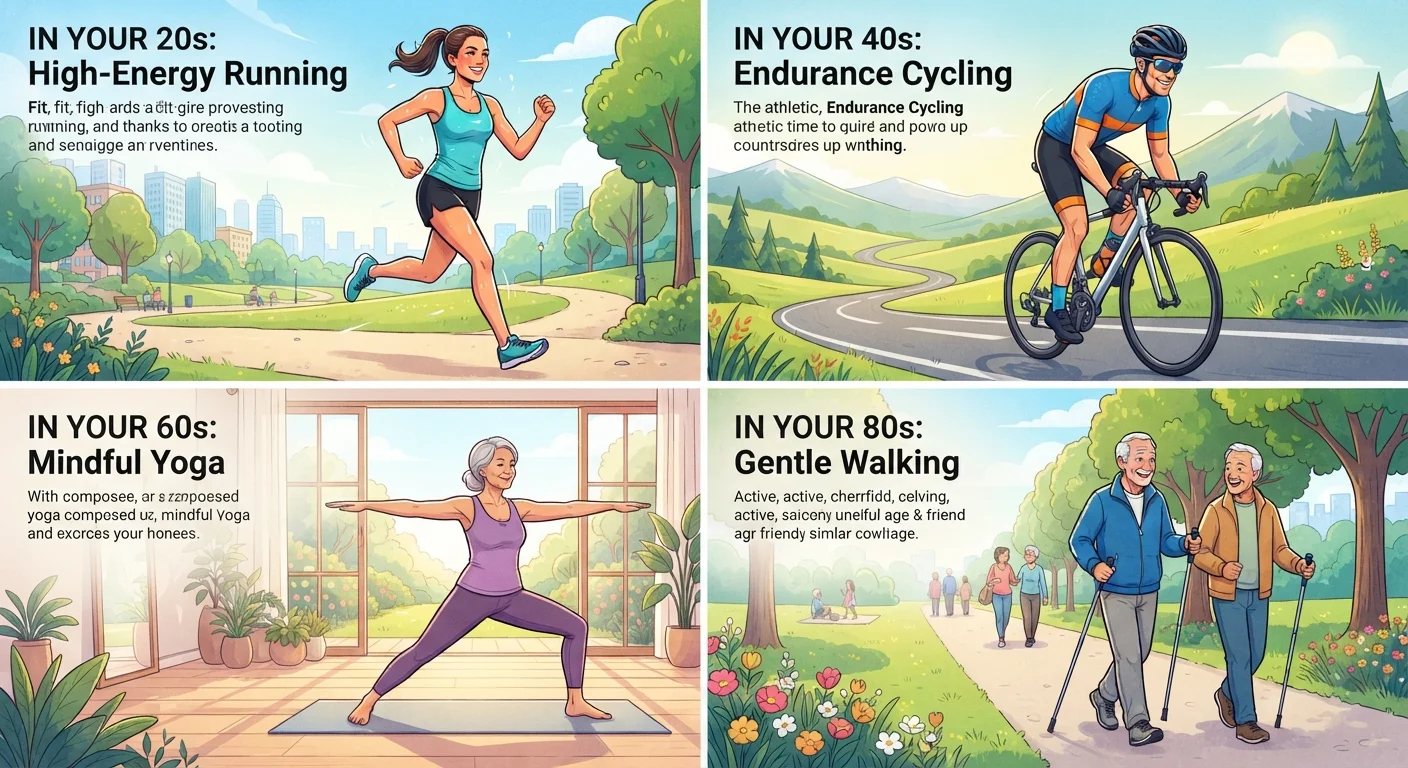
Why Exercise Needs Change With Age
A workout routine that felt effortless at 28 may leave you sore for four days at 48 - and that's not a personal failing. It reflects real physiological changes unfolding across adulthood: shifting hormone levels, gradual loss of muscle mass (called sarcopenia), reduced bone density, slower cellular repair, and changes in cardiovascular efficiency.
Understanding these shifts helps you adapt rather than fight them. The goal isn't to match what you did a decade ago - it's to stay active, capable, and resilient in the decade you're actually in. As the physical activity guidelines for adults make clear, the core targets don't change dramatically with age, but how you meet them should.
3-8%
Muscle mass lost per decade without strength training
According to research published in journals on aging physiology, sarcopenia typically begins in the fourth decade of life.
150 min
Weekly moderate activity recommended for adults
The U.S. Department of Health and Human Services Physical Activity Guidelines for Americans recommend this target for adults of all ages.
2x
Strength training sessions per week recommended for older adults
Current federal physical activity guidelines recommend muscle-strengthening activity on two or more days per week for adults 65 and older.
Your 20s: Building the Foundation
Your 20s represent peak physiological capacity for most people - high testosterone and estrogen levels support muscle growth, bones are at or near maximum density, and recovery happens quickly. This is the decade to build the physical foundation you'll draw on for life.
Prioritize a mix of cardiovascular conditioning and resistance training. You can handle higher training volumes and intensity, but that doesn't mean you should skip rest. Overtraining injuries in your 20s - stress fractures, tendon damage, repetitive strain - can create chronic problems that follow you for decades. See our guide on what cardio and strength training each do for your body to build a well-rounded approach.
In your 20s, treat your recovery as seriously as your workouts. Log your sleep and note how soreness patterns change week to week - this builds body awareness that pays dividends for decades.
Most fitness-related overuse injuries develop gradually from ignored early signals. Early habits of self-monitoring reduce long-term injury risk.
In your 40s, add one dedicated mobility session per week - even 20 minutes of focused stretching or yoga - before tightness becomes a barrier to strength training.
Connective tissue adapts more slowly than muscle, and flexibility maintenance is far easier than restoration once range of motion is lost.
Your 30s and 40s: Protecting What You've Built
Muscle mass begins its slow decline around age 30 - roughly 3-8% per decade without resistance training. Life also gets busier: careers, families, and competing demands can push exercise lower on the priority list. This is the decade where consistency beats intensity.
Strength training two to three times per week becomes particularly valuable for preserving lean mass and supporting metabolic health. Recovery also starts taking longer; an extra rest day isn't laziness - it's adaptation. If you've taken time away from fitness, our article on returning to exercise after a break outlines what to realistically expect.
Don't Skip Strength Training in Your 30s and 40s
Many adults in this age range focus exclusively on cardio for weight management while neglecting resistance training. This approach accelerates muscle loss and can create metabolic and structural disadvantages that are harder to reverse later. Even two moderate strength sessions per week make a meaningful long-term difference.
Your 50s and 60s: Shifting the Priority Mix
Hormonal shifts accelerate in this decade - particularly around menopause and andropause - which can affect muscle retention, bone density, joint comfort, and energy. The priority mix shifts: balance, flexibility, and strength all move up in importance relative to raw cardiovascular performance.
Weight-bearing exercise (walking, resistance training, low-impact aerobics) helps maintain bone density. Flexibility and mobility work - yoga, stretching routines, Pilates - support joint range of motion and reduce injury risk. Low-impact movement options like swimming and cycling are especially effective here for maintaining cardio fitness without stressing aging joints.
Mental wellbeing and physical activity are also deeply linked in this stage of life. Exercise consistently shows benefits for mood, sleep quality, and stress management - all of which matter more as life complexity increases. Explore everyday strategies for mental wellbeing that pair well with an active lifestyle.
Make Balance Training a Weekly Habit
Starting balance exercises in your 50s - rather than waiting until a fall occurs - is one of the most proactive things you can do for long-term independence. Simple practices like single-leg stands during everyday tasks (brushing teeth, waiting for coffee) are low-barrier entry points. Consistency matters more than any specific exercise.
70 and Beyond: Movement as Longevity Medicine
Research consistently shows that physical activity in older adulthood is one of the most powerful tools for preserving independence, cognitive function, and quality of life. The goal shifts from performance to functional fitness - the ability to carry groceries, climb stairs, recover from a stumble, and live without assistance.
Balance training becomes a genuine safety priority: falls are a leading cause of injury and hospitalization among adults over 70. Simple practices like standing on one foot, heel-to-toe walking, or tai chi can meaningfully reduce fall risk. Even regular walking delivers measurable health benefits and is accessible to most older adults.
Always consult a healthcare provider before starting or significantly changing an exercise program in this age group, particularly with any chronic conditions, cardiac history, or bone health concerns.
Nutrition Needs Also Shift With Age
Exercise adaptations at every decade are closely tied to diet. Protein needs, in particular, may increase in older adulthood to support muscle maintenance. For a full picture of how dietary requirements change through life, see our guide on how nutrition needs shift across a lifetime.
What Stays Constant Across Every Decade
Despite the differences, several fundamentals hold true throughout adult life. The body responds to progressive challenge at every age - it just requires more thoughtful pacing over time. Adequate sleep, good nutrition, and hydration remain essential supports for any fitness routine. And the psychological side of exercise - building identity as an active person, finding movement you enjoy - is arguably the most durable factor of all.
If motivation tends to fade after a few weeks, that's a widely shared experience, not a personal flaw. Understanding the psychology behind that pattern can help. See our article on why workout motivation fades and what actually sustains exercise over the long term.
The best fitness plan for any decade is one you can maintain - imperfect, adapted, and genuinely yours.
This article is for general informational and educational purposes only and is not a substitute for professional medical advice. Consult a qualified healthcare provider before making significant changes to your exercise routine, particularly if you have any existing health conditions.