
Why Payoff Strategy Matters
When you're carrying multiple debts - credit cards, personal loans, medical bills - simply making minimum payments keeps accounts current but rarely moves the needle on balances. Interest accumulates, and payoff timelines stretch. A deliberate payoff strategy channels any extra money you can free up toward eliminating individual debts one at a time, rather than spreading it thin.
Two frameworks dominate this space: the debt snowball and the debt avalanche. They share the same basic mechanic - pay minimums everywhere, put extra funds toward one priority debt - but differ fundamentally in how they rank that priority. If you're new to how debt and interest work, the primer on credit and debt basics is a useful starting point before diving into payoff tactics.
How the Debt Snowball Works
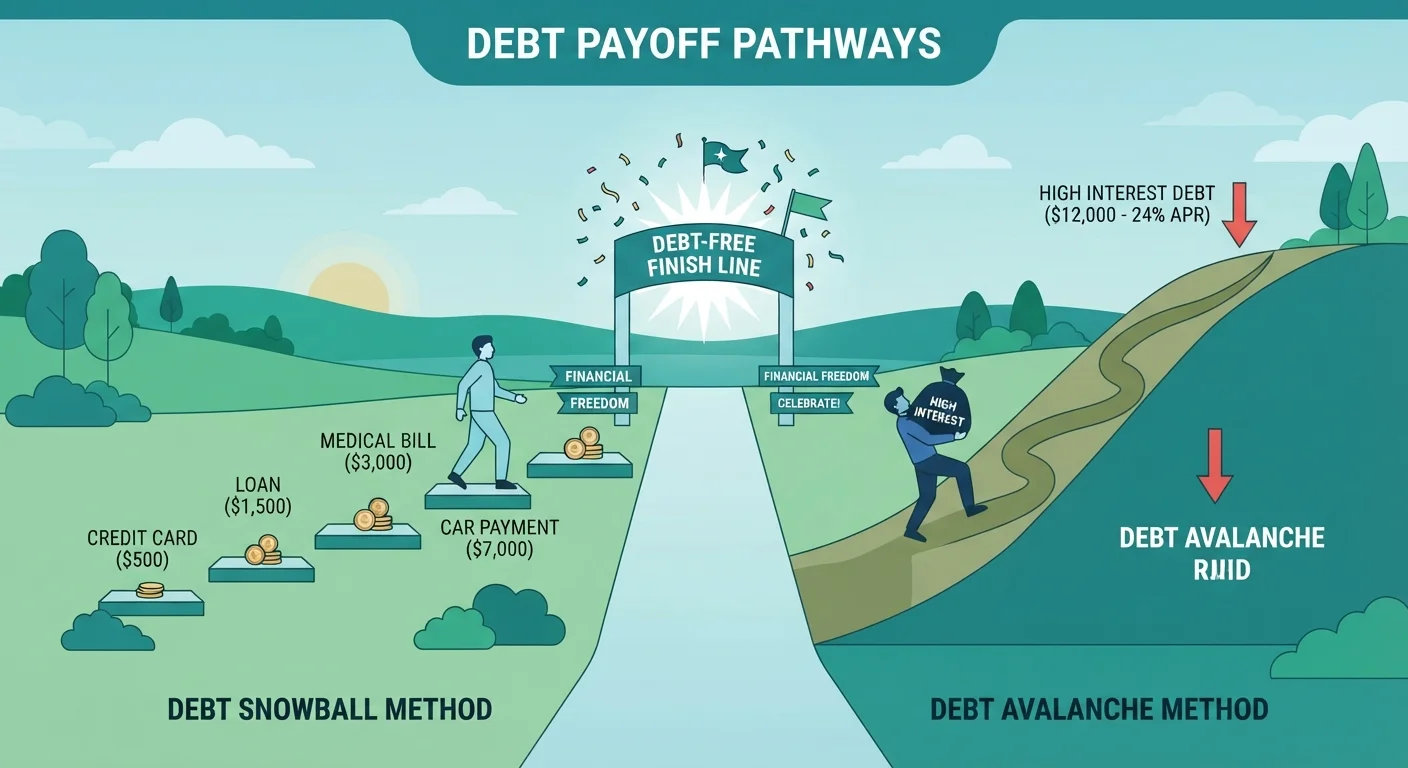
The snowball method orders your debts from smallest balance to largest, regardless of interest rate. You direct all extra payment capacity toward the smallest debt while maintaining minimums on everything else. Once that balance reaches zero, you roll its entire payment - minimum plus extra - into attacking the next-smallest debt. The payment amount compounds like a snowball gathering mass downhill.
The primary advantage is psychological. Eliminating a debt entirely, even a small one, delivers a concrete sense of progress. Research in behavioral finance suggests that completing discrete goals reinforces the habits needed to keep going. For people who have started and abandoned debt payoff plans before, the snowball's early wins can provide the motivation that a longer-horizon strategy might not.
The trade-off: if your smallest debts carry low interest rates and your larger debts carry high ones, you may pay more in total interest over the life of the plan compared with other approaches.
List Every Debt Before Choosing a Method
Before committing to either strategy, write out every debt you carry - balance, interest rate, and minimum payment. This snapshot makes it easier to see where the snowball and avalanche would diverge for your specific situation, and helps you spot which debts are costing you the most. For help with key terms like APR, see the credit and debt glossary.
How the Debt Avalanche Works
The avalanche method reorders that same list by interest rate, highest to lowest. Extra payments attack whichever debt is costing you the most per dollar borrowed, regardless of its balance size. Once that debt is eliminated, the freed-up payment cascades to the next-highest-rate debt.
Mathematically, the avalanche minimizes total interest paid over time. If your highest-rate debt also happens to carry a large balance, the payoff timeline for that first target can feel long - which is the method's key challenge. Progress is real, but it can be harder to see month to month, especially if balances are declining slowly. This is where the avalanche demands more patience and discipline than the snowball.
It's worth noting that the interest savings advantage of the avalanche varies significantly depending on the rate spread between your debts. If your debts carry similar rates, the practical difference between the two methods may be small.
| Debt Snowball | Debt Avalanche | |
|---|---|---|
| Ordering principle | Smallest balance first | Highest interest rate first |
| Total interest paid | Potentially higher | Typically lower |
| Time to first payoff | Often faster (small balances) | Varies; can take longer |
| Psychological momentum | Strong early wins | Wins may come later |
| Mathematical efficiency | Lower in most scenarios | Higher in most scenarios |
| Best suited for | Motivation-driven payers | Discipline-driven payers |
Factors That Influence Which Approach Fits
No single framework fits everyone. A few variables are worth thinking through:
- Interest rate spread: If your highest-rate debt carries a rate dramatically higher than your others, the avalanche's interest savings can be substantial. If rates are clustered closely, the gap narrows.
- Balance distribution: Several small, low-balance debts and one large high-rate debt may make the snowball efficient in clearing clutter before tackling the big balance.
- Behavioral track record: If past payoff efforts stalled, motivation is a real variable - not a soft one. Choosing the method you'll sustain matters more than the one that looks best on a spreadsheet.
- Income stability: Those with variable income may benefit from building flexibility into their plan, which either method can accommodate as long as minimums remain covered.
For those also considering debt consolidation, it's worth understanding how consolidation interacts with payoff strategies - it can simplify the picture, but it introduces its own costs and trade-offs.
Putting a Strategy Into Practice
Getting started requires a clear inventory: list every debt you carry, its current balance, minimum payment, and interest rate. From there, apply whichever ordering principle you've chosen and confirm you can cover all minimums before directing extra funds anywhere.
Even small amounts of extra payment - $25 or $50 per month - can meaningfully shorten payoff timelines when applied consistently to a single target. Building this consistency is closely tied to broader habits around tracking what you owe and managing cash flow. The principles for keeping debt manageable covers those habits in depth.
If you carry a personal loan as part of your debt mix, it's also worth understanding how that account behaves differently from revolving credit - the mechanics of personal loan repayment outlines what changes once you're in repayment.
77%
Americans carrying some form of debt
According to Experian's 2023 Consumer Credit Review, the vast majority of U.S. adults carry at least one type of outstanding debt.
20%+
Average credit card APR in recent years
The Federal Reserve has reported average credit card interest rates exceeding 20% annually in recent periods, underscoring the cost of carrying revolving balances.
This article is for general informational and educational purposes only and does not constitute personalized financial, tax, or legal advice. Consult a qualified financial professional before making decisions about your own debt repayment strategy.