How the "50% Off" Number Gets Made
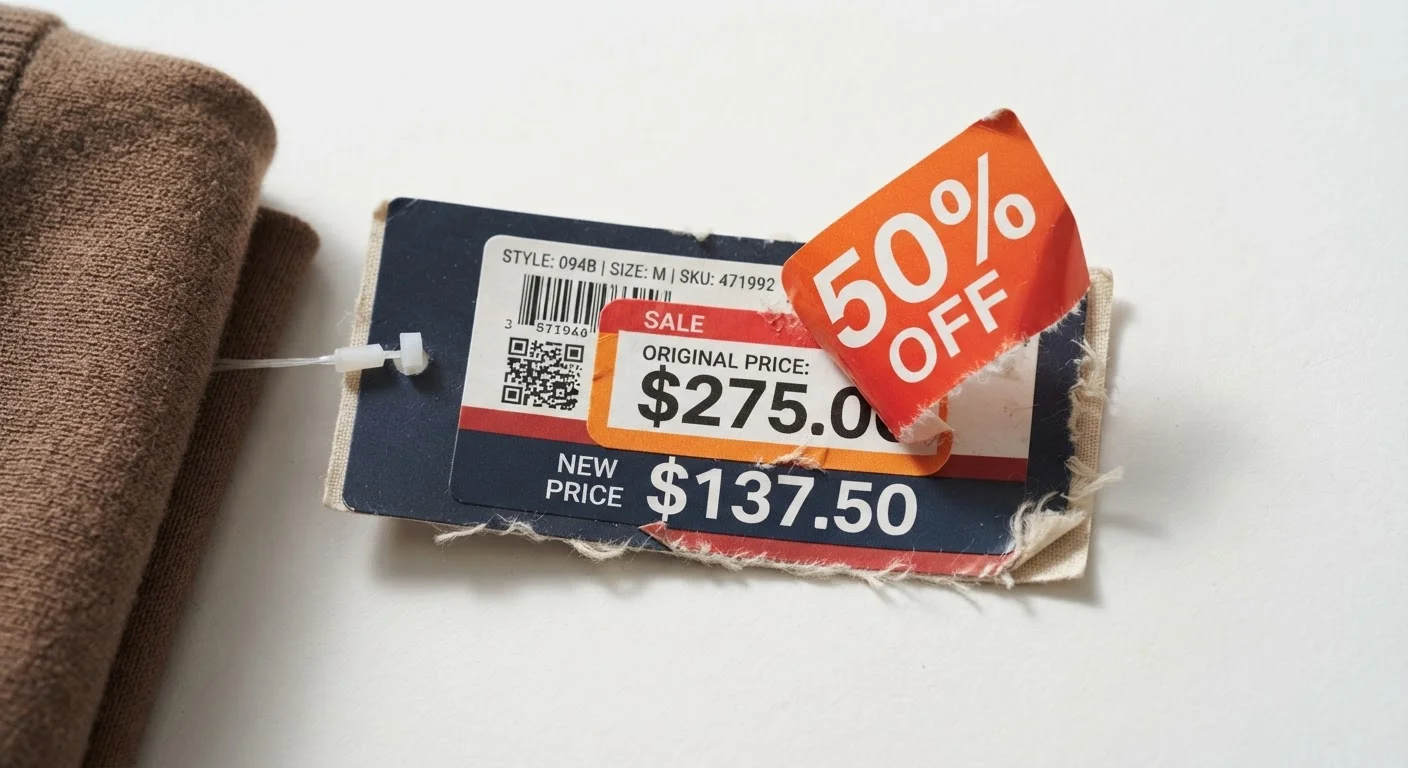
When you see a price tag reading "Was $100, Now $50," your brain registers a clear win: half off. But that math only works if the $100 was a real price - one the product was genuinely sold at, for a meaningful period, to actual buyers.
In many cases, it wasn't. Retailers have long used a practice called reference pricing: establishing a high "original" or "regular" price as a benchmark, then selling at a lower number that appears to be a discount. The reference price may be the manufacturer's suggested retail price (MSRP), a price the item was briefly listed at, or a number the retailer set without any real sales ever occurring at that level.
The result is a discount percentage that's mathematically real but practically meaningless. You're comparing today's price to a fiction.
FTC Guidelines on Reference Pricing
The Federal Trade Commission's Guides Against Deceptive Pricing state that advertised former prices should be prices at which products were actually offered to the public for a reasonably substantial period of time. However, terms like "compare at," "value," and "suggested retail" occupy a grayer area, and the guidelines apply differently depending on how a retailer phrases its price claims. Shoppers cannot rely on regulation alone to protect them from misleading discount framing.
The Tactics Retailers Commonly Use
Understanding specific techniques makes them easier to spot:
- Phantom MSRPs: Many products - particularly in electronics, furniture, and bedding - carry manufacturer's suggested retail prices that no retailer actually charges. Discounting from an MSRP that was never the real market price creates an illusion of savings.
- Pre-event markups: Consumer reporting has documented that some products are quietly raised in price in the weeks before a major sale event, then "discounted" back to their normal price during the sale itself. The percentage looks dramatic; the actual savings may be minimal.
- Short-lived list prices: A product may be listed at a high price for only a day or two - technically making it the "original" price - before being permanently reduced. The sale tag is accurate in a narrow legal sense, but it's still designed to mislead.
- "Compare at" ambiguity: This phrase often appears in apparel and home goods retail. It typically references a price at some other, often unnamed, retailer or a general market price - not necessarily what you would actually pay elsewhere.
These tactics are especially prevalent around Black Friday, end-of-season clearances, and holiday events, where shoppers are primed to act quickly on perceived deals. See how these habits quietly affect budgets in this breakdown of common overpaying habits.
Check Price History Before You Buy
Before trusting a sale badge, look up the item's price history using a browser extension or price tracking website. A genuine discount will show a clear drop from a price the product held steadily over weeks, not a brief spike followed by a "return" to a lower number. This takes under a minute and is one of the highest-value habits you can build as an online shopper.
How to Check Whether a Discount Is Real
The good news: verifying a price has become much easier than it used to be. A few practical methods:
- Use price history tools. Several browser extensions and independent websites track historical pricing for products across major retail platforms. If a product's "original" price only appeared once, briefly, those tools will show it. A genuine discount will show a sustained drop from a price the product held for weeks or months.
- Search the same item across retailers. If a product is available elsewhere at a price close to today's "sale" price, that tells you the "discount" is largely cosmetic. A real deal will be noticeably below what other sellers are charging.
- Anchor on total cost, not percentage. As covered in our guide to hidden product costs, shipping fees, compatibility add-ons, and accessories often determine whether a purchase represents genuine value. A 40% discount that requires a $25 accessory to function may not beat a non-discounted item that ships free and includes everything.
- Check the product's price history before a sale event. If you know a sale is coming, look up the item now. A baseline gives you a real comparison point when the promotional window opens.
For a full walkthrough of finding and evaluating genuine deals, see the complete guide to identifying real online discounts.
~33%
Black Friday deals found to be cheaper earlier in the year
Consumer research and price tracking analyses have consistently found that a significant portion of Black Friday "deals" were available at lower or equivalent prices at other points during the year.
MSRP gap
Difference between MSRP and typical selling price
For many product categories - including mattresses, furniture, and consumer electronics - the MSRP is routinely 30-50% above what the item actually sells for at most retailers, making MSRP-based discounts structurally misleading.
What a Real Discount Actually Looks Like
Genuine price drops do exist - and they share recognizable patterns. A real discount typically reflects a product being priced below its sustained market price, not just below its stated "original" price. You can learn more about the specific signals in this explainer on what separates a true price drop from a marketing illusion.
Key signals worth looking for: the item's price history shows a clear, sustained higher price followed by a drop; multiple independent retailers reflect the same reduction; and the total cost - shipping included - is meaningfully lower than your baseline. A large percentage badge without any of these signals is worth treating with skepticism.
The broader lesson is straightforward: the discount number on a tag is calculated by the retailer, based on a price the retailer set. Shifting your attention from the percentage to the actual price - relative to real market data - is how you move from reacting to a marketing message to making an informed decision. It's also worth questioning other assumptions shoppers commonly make, as explored in this look at shopping myths that cost consumers real money.