Why the Rate You See Isn't the Rate You Get
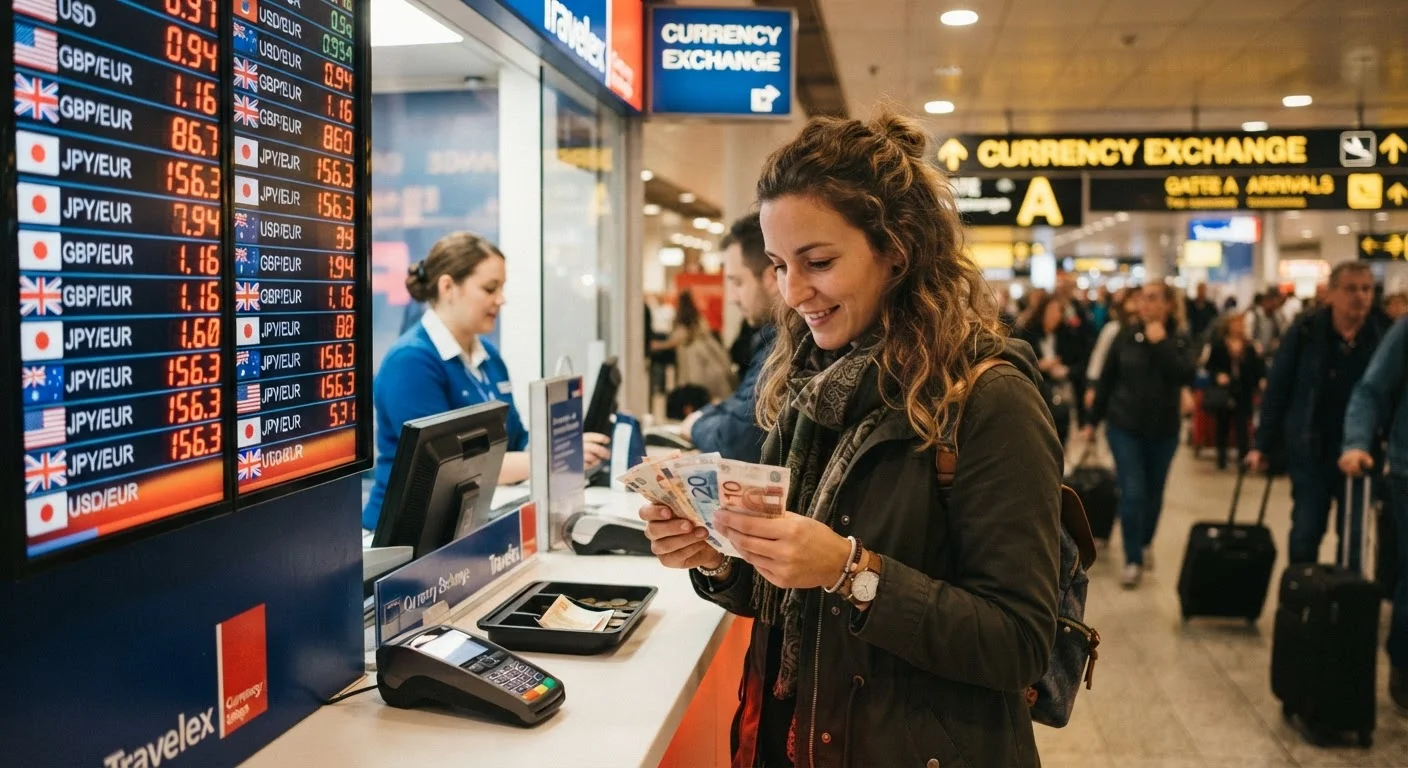
The mid-market exchange rate - the one quoted on financial apps and search engines - is the midpoint between global buying and selling prices for a currency pair. It's a real rate, but it's not one that retail consumers typically access. Banks, kiosks, and exchange desks build a spread into every transaction: they buy your dollars at a rate slightly below mid-market and sell foreign currency at a rate slightly above it. That gap is their margin, and it varies enormously.
An airport kiosk in a high-traffic terminal might apply a spread of 8-12% on top of mid-market, while a local bank or ATM withdrawal might land within 1-3%. On a $500 exchange, that difference can mean $35-$55 more or less in your pocket. The lesson: visible fees on the sign are only part of the story - the rate itself matters just as much.
Up to 12%
Typical spread at airport exchange kiosks
Industry analyses of currency exchange options consistently find that airport kiosks apply some of the widest spreads relative to mid-market rates, often ranging from 5-12%.
1-3%
Common foreign transaction fee on US cards
Most standard US bank cards and credit cards charge a foreign transaction fee between 1% and 3% on purchases processed in a foreign currency.
3-7%
Extra cost of dynamic currency conversion
Consumer finance researchers and travel publications have repeatedly documented that merchant-applied dynamic currency conversion rates run 3-7% above card-network rates.
Common Exchange Channels and Their Trade-Offs
Understanding where you can exchange money - and what each channel actually costs - is the core of making informed decisions abroad.
Airport Currency Kiosks
Convenient? Absolutely. Cost-effective? Rarely. Airport exchange desks operate in high-overhead, high-captive-audience environments. Their spreads tend to be the widest of any mainstream option. That said, if you need a small amount of local cash immediately upon landing, exchanging just enough to cover a taxi or transit pass can be a pragmatic trade-off. See our common misconceptions about international airports for more on navigating arrival logistics.
Local ATMs
Withdrawing from a local ATM in your destination country typically gives you a rate close to mid-market, because the transaction clears through international banking networks. The watch-outs: your home bank may charge a foreign ATM fee (often $3-$5 per withdrawal) plus a foreign transaction fee (often 1-3%). Using ATMs affiliated with major local banks generally reduces the risk of skimming and predatory conversion prompts.
Your Home Bank's Travel Card or Debit Card
Some banks and credit unions offer accounts specifically designed for international use, with reduced or waived foreign transaction fees. These can be among the most transparent and competitive options, since the rate applied is typically the network (Visa or Mastercard) rate for that day - very close to mid-market.
In-Country Exchange Offices
These vary wildly. An established exchange office near a city's financial district often posts competitive rates. A colorful booth in a tourist souvenir district may not. Always compare the offered rate against mid-market before handing over cash, and confirm whether commissions are added after the headline rate.
Compare Before You Convert
Before exchanging cash anywhere - kiosk, bank, or exchange office - pull up the current mid-market rate on a currency tool or search engine. Then calculate what you'd receive at the offered rate. That percentage difference is your real cost, regardless of what the fee sign says. Taking 60 seconds to compare can save you meaningfully on larger exchanges.
Dynamic Currency Conversion: The Hidden Trap at the Register
One of the most common ways travelers unknowingly lose money doesn't involve an exchange desk at all - it happens at the payment terminal. Dynamic currency conversion (DCC) occurs when a merchant's card reader detects your foreign card and offers to process the payment in US dollars instead of local currency. The screen might say something like "Pay $42.17 USD or 38.50 EUR - which would you prefer?"
The catch: the merchant (or their payment processor) sets that conversion rate, and it's typically 3-7% worse than the rate your card issuer would apply. By choosing USD, you're opting into their conversion rather than your bank's. Always select the local currency option at payment terminals abroad. This one habit alone can prevent a quiet but consistent drain on your travel budget. For a broader view of how these friction points add up, our guide on navigating international travel friction points covers card declines, bank communication, and other common snags.
“The single most expensive financial habit of many international travelers isn't big spending - it's repeatedly absorbing small, avoidable conversion costs that compound across dozens of transactions.”
— Travel & Trips Editorial Team, Editorial analysis based on widely reported currency exchange research
Practical Steps Before and During Your Trip
A little preparation dramatically reduces the stress - and cost - of managing money abroad.
- Notify your bank and card issuers before departure. Card declines due to suspected fraud are one of the most disruptive friction points in international travel. Most banks allow you to set travel notifications online or by phone.
- Research the cash culture of your destination. Some countries (Germany, Japan, parts of Southeast Asia) remain heavily cash-dependent. Others (Scandinavia, much of Western Europe) are nearly cashless. Knowing this helps you calibrate how much local currency to carry.
- Carry at least two payment methods. A card and a moderate cash reserve ensures you're not stranded if one fails. Keep them in separate locations.
- Check fees before each ATM withdrawal. Many ATMs abroad display their fees on screen before you confirm the transaction. You can cancel and try another machine if the fee seems excessive.
- Budget for exchange costs as a travel expense. If you're working through a trip budget, factor in a rough 2-3% buffer for currency-related friction. Our overview of where your travel money actually goes covers how these smaller costs fit into the full financial picture of a trip.
Cash Needs Vary by Destination
There's no universal answer to how much cash to carry abroad. Some destinations have robust card infrastructure in cities but limited acceptance in rural or traditional market areas. It's worth researching your specific destinations before departure rather than assuming a one-size approach. Local tourism boards and travel forums can be useful for destination-specific payment norms. Also consider how currency management fits into your broader strategy for keeping your trip on budget once you've left home.
This article is for general informational purposes only and does not constitute financial or legal advice. Exchange rates, fees, and banking policies vary by institution and destination. Verify current terms with your card issuer and consult official sources before traveling.