Why National Park Visits Go Wrong More Often Than You'd Think
America's national parks host hundreds of millions of visits each year, yet a surprising share of those trips are plagued by avoidable frustrations - clogged parking lots, denied trail access, exhausted hikers, and itineraries that collapse by day two. The parks themselves haven't changed; what's changed is how much planning they now require. Visitor volumes have surged at many flagship parks, and land managers have responded with reservation systems, permit lotteries, and timed-entry windows that didn't exist a decade ago.
The good news is that nearly every common mistake has a clear fix. Whether you're planning your first park trip or your fifteenth, understanding where things go sideways - and why - is the fastest route to a genuinely great experience. See our practical preparation checklist for a full rundown of what to confirm before you arrive.
Assuming no reservation is needed because the park is technically open year-round.
Why it happens: Many visitors assume national parks work like state parks or open wilderness areas - show up and explore. In reality, high-demand parks like Zion, Acadia, and Rocky Mountain now require timed-entry reservations that must be secured weeks or months ahead.
Misjudging trail difficulty by relying only on listed mileage.
Why it happens: A six-mile round-trip sounds manageable to most people, but park maps rarely communicate elevation gain, exposed scrambling sections, or altitude effects prominently enough. Visitors calibrate based on flat urban walking and arrive underprepared.
Arriving at iconic viewpoints or trailheads during peak hours expecting available parking.
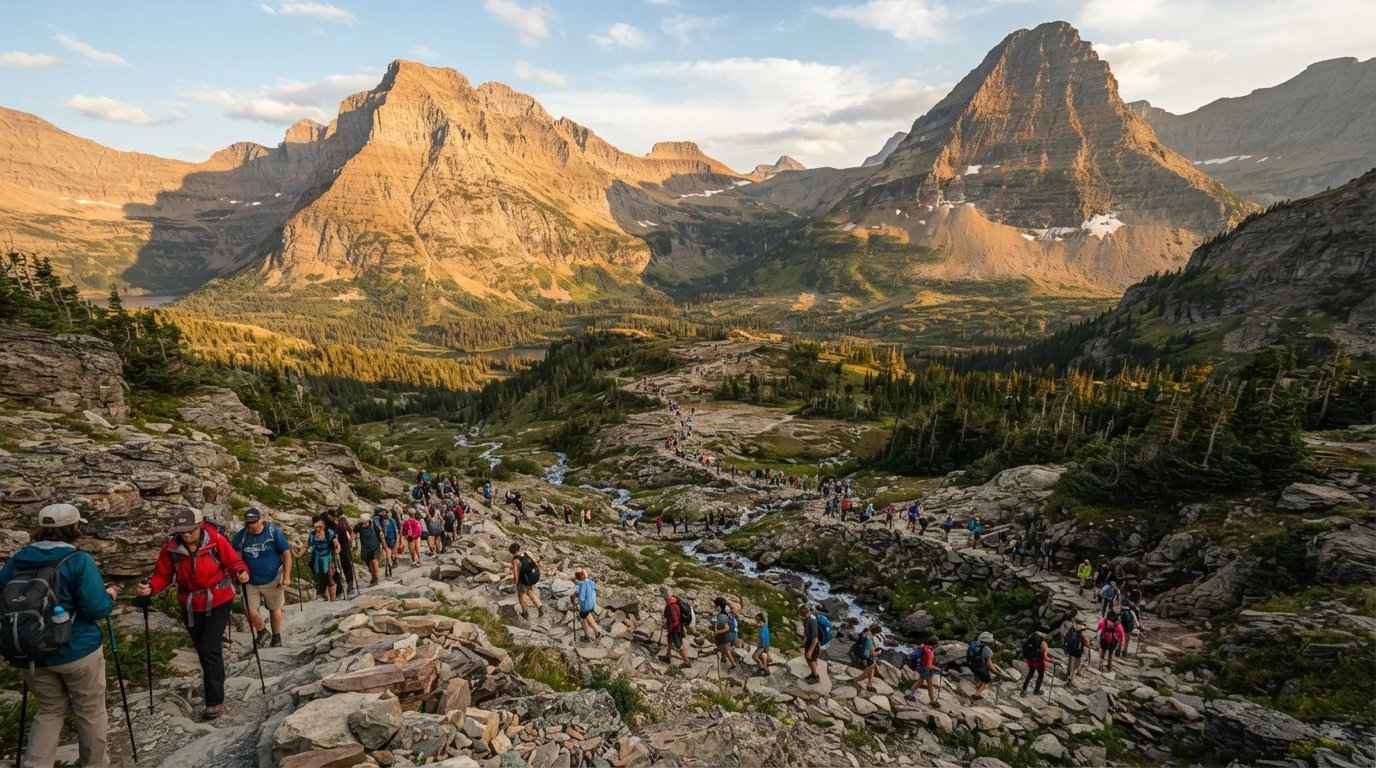
Why it happens: Travel content tends to showcase parks at their photogenic best without flagging that the lots at Angels Landing or Glacier's Logan Pass fill by 7 a.m. in summer. First-time visitors plan to arrive by 9 or 10 a.m. and find no entry.
Packing only for the forecasted morning weather without accounting for rapid afternoon changes.
Why it happens: Visitors check the morning forecast, see sunshine, and leave rain gear and warm layers at the hotel. Mountain and high-desert environments produce fast-moving afternoon thunderstorms and temperature swings that forecasts often underrepresent.
Relying entirely on a smartphone for navigation and payment inside the park.
Why it happens: Modern travelers are accustomed to cell coverage everywhere; the assumption extends to parks by default. But dead zones cover vast portions of even popular parks, and many entrance stations and camp stores still accept cash only.
Underestimating how much water and food a full day of hiking at elevation actually requires.
Why it happens: General hydration advice doesn't account for sun exposure, dry air, altitude, and sustained physical output simultaneously. Visitors often carry a single water bottle for trails that warrant two liters or more per person.
Planning Oversights That Compound on the Trail
Beyond permit and reservation errors, the most damaging mistakes tend to be logistical blind spots that only become obvious once you're deep into a park. Cell service is unreliable or absent across enormous stretches of wilderness, meaning digital maps, downloaded podcasts, and mobile payment apps all stop working simultaneously. Downloading offline maps before departure - and carrying a paper backup - is a habit that still saves trips regularly.
325M+
Annual US national park visits
The National Park Service reported over 325 million recreational visits across the system in recent years, reflecting sustained post-pandemic demand.
~40%
Parks with active entry reservation systems
A growing share of the most-visited parks now use timed-entry or permit systems, a significant increase from pre-2020 levels.
Weather is another constant surprise. Afternoon thunderstorms are a near-daily occurrence in the Rocky Mountain parks during summer. Temperatures at elevation can swing 30°F or more in a single afternoon. Visitors who pack only for the morning forecast often find themselves dangerously underprepared by 3 p.m. Layering systems and rain shells take up minimal space and make an enormous difference.
For a broader look at how planning assumptions unravel in the field, explore what makes even well-researched trips go sideways - many of the same dynamics apply to park travel. And if the scale of Western parks feels daunting, first-time visitors to the American West often share the same misconceptions about distances and terrain.
Cell Dead Zones Are Larger Than You Expect
In many national parks - including Yellowstone, Grand Canyon, and Great Smoky Mountains - cell coverage is either absent or limited to a few developed areas. Relying on Google Maps or real-time weather apps mid-trail is not a reliable safety strategy. Download offline resources before you leave the trailhead parking lot, and let someone outside the park know your planned route and return time.
Understanding what each park region actually delivers can also reshape your expectations before you book. A regional breakdown of America's national parks can help match your travel style to the right landscape - whether that's the arid Southwest, the lush Pacific Northwest, or the glacier-carved ranges of the Northern Rockies.