
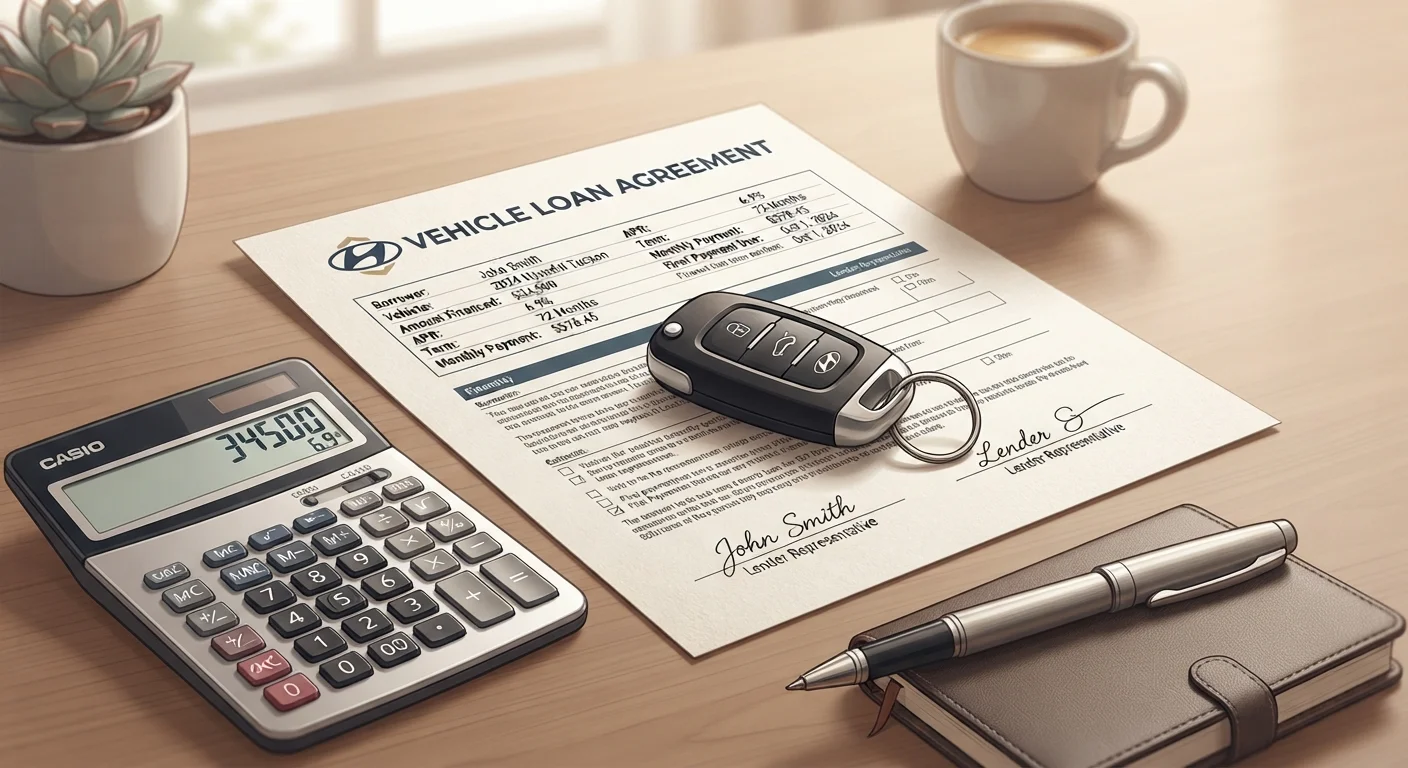
The Core Components: Principal, Interest, and Term
Every auto loan is built on three fundamental elements. The principal is the amount you borrow - essentially the vehicle's purchase price minus any down payment or trade-in value. The interest rate is the percentage the lender charges annually to lend you that money. The loan term is the agreed repayment window, commonly ranging from 36 to 72 months, though some lenders offer terms up to 84 months.
These three elements interact directly: a lower principal or shorter term means less total interest paid, while a longer term stretches payments out but increases the overall cost of the loan. For example, borrowing $25,000 at 7% APR over 48 months results in meaningfully less total interest than the same loan stretched over 72 months, even though the monthly payment is lower with the longer term.
For a broader look at how carrying a loan compares to owning a vehicle outright, see owning a car outright vs. carrying a loan.
$48,000+
Average new vehicle transaction price in the US
According to Federal Reserve and industry tracking data, average new car prices have risen substantially over recent years, making financing a common necessity for most buyers.
68 months
Average auto loan term for new vehicles
Consumer Financial Protection Bureau data shows loan terms have been lengthening, with many buyers now financing well beyond the traditional 48-month window.
~85%
Share of new vehicles purchased with financing
Industry research consistently shows the vast majority of new car purchases in the US involve some form of financing rather than an outright cash purchase.
What APR Actually Tells You
The APR is the most useful single number when evaluating an auto loan because it captures the full annual cost of borrowing, including the interest rate and any lender fees built into the financing. Two loans with identical interest rates can have different APRs if one includes origination or documentation fees.
Your APR is determined primarily by your credit score, the loan term, the age of the vehicle (new vs. used), and the lender's own pricing. Used vehicles generally carry higher rates than new ones because they represent greater risk to the lender. Shopping multiple lenders before settling on financing - whether through a bank, credit union, or dealership - is one of the most straightforward ways to find a lower APR. For a direct comparison of those routes, see financing through a dealership vs. a bank or credit union.
Get Pre-Approved Before You Shop
Seeking pre-approval from a bank or credit union before visiting a dealership gives you a concrete rate benchmark to compare against dealer financing offers. Pre-approval also clarifies your budget and strengthens your negotiating position. Pre-approval is typically a soft or conditional credit inquiry, but submitting multiple formal applications within a short window (usually 14-45 days) is often treated as a single inquiry by major credit scoring models.
How Your Monthly Payment Is Calculated
Lenders use a standard amortization formula to calculate your monthly payment. Each payment covers two things: a portion of the principal and the interest accrued since your last payment. In the early months of the loan, more of each payment goes toward interest; as the principal shrinks, the interest portion decreases and more goes toward the balance itself.
This structure means that if you can make extra payments toward principal early in the loan, you reduce the balance faster and pay less total interest - provided your agreement doesn't include a prepayment penalty. Always review your loan contract for that clause before paying ahead of schedule.
Understanding this structure is foundational before you sit down to sign. For a step-by-step walkthrough of the full process, getting your first car loan covers what to expect at every stage.
Collateral, Liens, and What Happens If You Default
Unlike a personal loan, an auto loan is secured debt - the vehicle itself is the collateral. The lender places a lien on the vehicle's title, which means they have a legal claim to the car until the loan is repaid in full. You typically receive the clean title only after the final payment is made and the lien is released.
If you stop making payments, the lender has the right to repossess the vehicle - often without advance court action in most US states. Repossession also results in serious damage to your credit profile and may not end the debt: if the car sells for less than what you owe, you could still be responsible for the deficiency balance.
For context on how secured auto debt compares to unsecured borrowing, our guide on taking on a personal loan explains the key differences in risk and repayment structure. More foundational information on managing borrowing is available through our Credit & Debt resource hub.
Co-Signers Change the Risk Picture
If a lender requires a co-signer due to limited credit history or a lower score, that co-signer becomes equally responsible for the debt. A missed payment affects both parties' credit profiles. Before agreeing to co-sign - or asking someone else to - review our guide on questions worth asking before co-signing a loan.
This article is for general informational purposes only and does not constitute financial or legal advice. Loan terms, rates, and regulations vary by lender, state, and individual circumstances. Consult a qualified financial professional before making borrowing decisions.