
Why the Garage Becomes a Catch-All
The garage is the only room in most American homes with no social pressure attached to it. Guests don't see it; daily life rarely demands it to look presentable. That structural invisibility is exactly why it fills up faster than any other space-and why clearing it out feels so overwhelming once you finally open the door and look around.
Garages tend to accumulate in three distinct waves: tools and hardware that were purchased for specific projects, seasonal gear that gets shoved in without a system, and the miscellaneous overflow from every other room in the house. The good news is that these categories respond well to simple, honest sorting. This checklist walks you through that process step by step.
If you've already worked through other parts of your home, the framework here will feel familiar. See our room-by-room decluttering walkthrough for context on how the garage fits into a broader household reset. And if you're thinking about how to keep the system from unraveling after you've built it, it's worth reading about organizing habits that tend to collapse quickly before you commit to a layout.
Never Trash Hazardous Materials
Old paint, motor oil, pesticides, and solvents cannot go into household trash or be poured down drains-doing so is often illegal and environmentally harmful. Contact your local waste management agency or check Earth911.com to find a nearby hazardous waste collection event. Many municipalities hold these regularly at no cost to residents.
Don't Overlook Fire Safety Clearances
Garages attached to the home are a common entry point for house fires. Keep combustible materials-rags soaked in finishing oils, propane tanks, gas cans-away from water heaters, furnaces, and electrical panels. Local fire codes often specify minimum clearances; check with your municipality if you're unsure what applies to your home.
What You'll Need Before You Begin
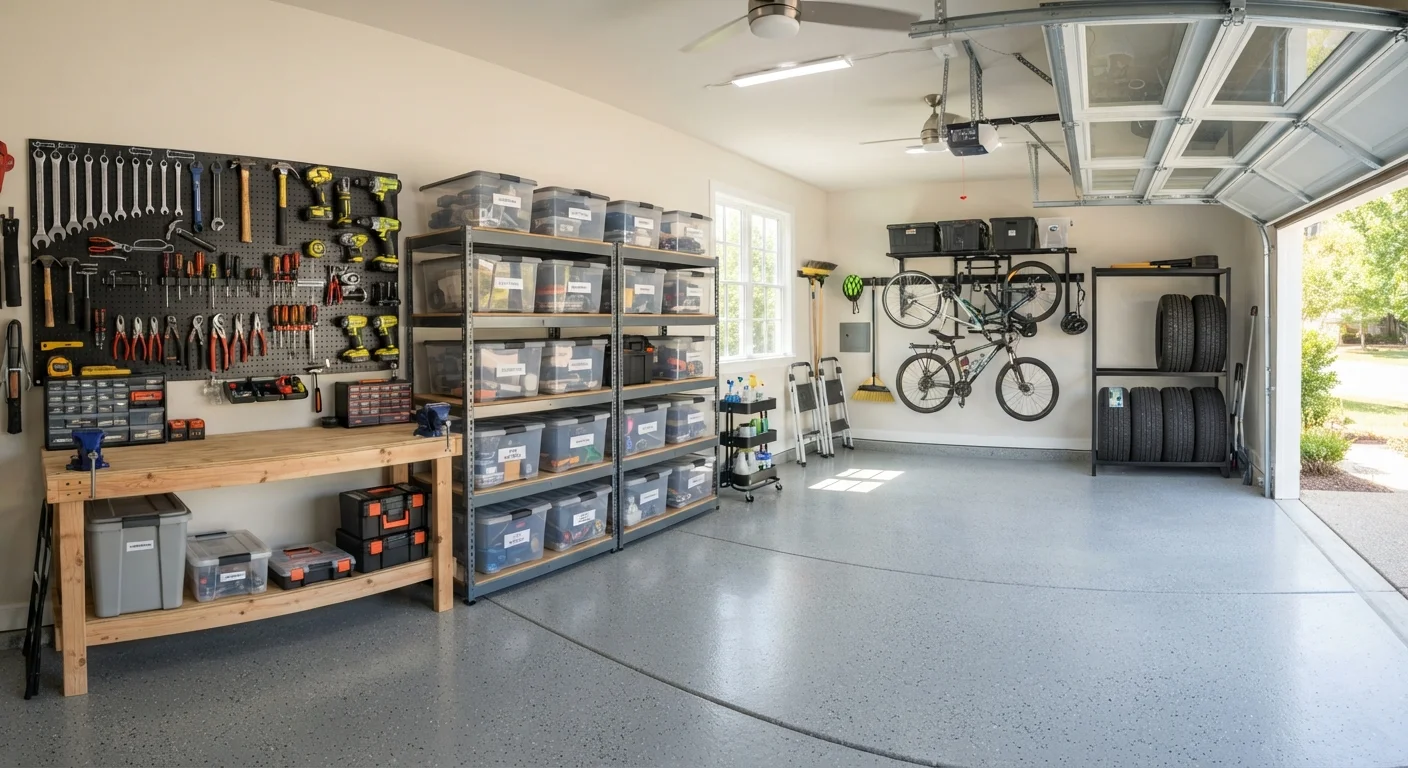
Trying to organize a garage without the right supplies on hand usually leads to stopping halfway through and losing momentum. Gather your materials the day before if possible. At minimum you'll need heavy-duty trash bags, a permanent marker, and several boxes or bins for sorting. Optional but genuinely useful additions-pegboards, metal shelving, and bike hooks-can be sourced afterward once you know exactly what you're keeping.
Heavy-duty trash bags
Collecting and removing discarded items safely without tearing.
Stackable lidded bins
Storing seasonal and categorized items in a way that's visible, labeled, and space-efficient.
Permanent markers
Labeling bins, shelves, and boxes so every item has a clearly identified home.
Pegboard and hooks
Wall-mounting frequently used hand tools to free up shelf and floor space.
Freestanding metal shelving unit
Creating vertical storage that keeps items off the floor and organized by category.
Bike hooks or ceiling pulley system
Storing bicycles overhead or on walls to reclaim valuable floor area.
The most important supply is time. A garage that took years to fill will not be reorganized in 45 minutes. Budget a realistic block, ideally a full morning or afternoon, and recruit a second person if the volume is significant.
Using the Checklist
The checklist below is built around five logical phases: setup, tools, seasonal gear, hazardous materials, and final configuration. Work through them in order-resist the urge to start organizing before you've finished sorting, because mixing those two tasks is one of the most common reasons garage projects stall.
The priority labels next to each item reflect how much impact it has on the outcome. Must items are non-negotiable for a functional result. Should items will significantly improve the system's durability. Nice-to-have items add polish and resilience but can be deferred if time is limited.
The same decision logic applies here as in seasonal clothing transitions-keep what you actively use, store what you seasonally rotate, and release what's been idle. Our guide on seasonal closet rotation uses a similar framework that translates well to garage gear.
The Floor Must Stay Passable
A garage floor cluttered with boxes, equipment, or bags creates a genuine safety hazard-particularly at night or during an emergency. No storage system is worth sacrificing a clear path to exits and vehicles. Before you consider organization complete, walk the full floor space and confirm that all pathways are obstacle-free.
Before You Start
Tools and Hardware
Seasonal and Outdoor Gear
Hazardous and Sensitive Materials
Final Setup and Maintenance
Keeping It Organized After Today
The hardest part of garage organization isn't the initial sort-it's maintaining the system over time. Garages drift back toward chaos because items get returned to the wrong spots and no one course-corrects until the problem is visible again. The most effective countermeasure is a brief monthly sweep, not another major overhaul.
If your garage is genuinely tight on square footage and you're storing items that belong in the house, it may be time to look at how other parts of your home use space. Even renters dealing with limited square footage apply principles worth borrowing-the constraints that come with small apartments often produce sharper, more intentional storage decisions than larger homes naturally develop.
A well-organized garage isn't a one-time achievement. It's a system that works because every item in it has a defined, logical place-and everyone in the household knows what that place is.