Why Constraints Can Be an Organizing Advantage
Living in a small apartment removes a temptation that derails organizing in larger homes: the ability to defer decisions. When you can't just close a spare room door or push things into an extra closet, you're forced to decide - keep, donate, or let go - on a much shorter timeline. That pressure, while occasionally frustrating, is also what makes small-space dwellers surprisingly good at maintaining systems over time.
If you're new to intentional organizing, a small apartment is actually a manageable starting point. The scope is limited, feedback is immediate, and the cost of a messy system is visible within days rather than months.
The challenge isn't finding more storage - it's making smarter decisions about what deserves to stay.
“Constraints are not the enemy of creativity - they're often the very thing that forces it. The same is true of organizing: limits clarify what actually matters.”
— Margareta Magnusson, Author of 'The Gentle Art of Swedish Death Cleaning'
Core Practices for Small-Space Organization
The following practices are specifically suited to compact living. They aren't generic tidying tips - they're approaches that account for the real constraints of limited square footage.
Apply a strict one-in, one-out rule for every category of item you own.
When storage is finite, adding without subtracting creates compounding pressure fast. A one-in, one-out rule builds a natural ceiling on accumulation and makes each purchase a deliberate choice rather than a reflex.
Assign every item a fixed, specific home - not a general area.
Vague homes ('somewhere in the kitchen') lead to clutter because nothing has a clear return point. Specific homes ('second drawer, left side') make putting things away as fast as getting them out.
Audit your storage containers every few months, not just what's inside them.
Containers that are too large invite filling. Containers that are too small cause spillover. The right container size signals a natural limit for that category of items.
Build a 5-minute daily reset into your routine rather than waiting for a weekend tidy.
Small spaces lose their calm faster than large ones - a few displaced items can make an entire room feel chaotic. Short daily resets prevent small disorder from becoming an overwhelming project.
Store items at their point of use, not in the most 'logical' central location.
In a small apartment, carrying things across the space to put them away creates friction - and that friction is often what causes clutter to accumulate near where items are used.
Quick Actions You Can Take This Week
Getting started doesn't require a full weekend overhaul. Small apartments respond well to short, focused sessions. These quick wins can shift how your space feels almost immediately.
If clutter tends to return faster than expected, it may be worth reviewing why certain organizing habits fail before committing to a system.
Making the Most of Vertical and Shared Zones
Floor space is the scarcest resource in a small apartment, which means walls and upper areas become critical. Vertical storage options - shelving, pegboards, over-door organizers, and wall hooks - can dramatically extend your usable space without expanding your footprint.
Think Height, Not Just Depth
Most apartments have more vertical room than residents ever use. Shelving that reaches toward the ceiling - even in a narrow corridor or above a doorway - can store seasonal items, reference books, or backup supplies without claiming any floor space. Check that anything stored high is lightweight and infrequently needed for safety.
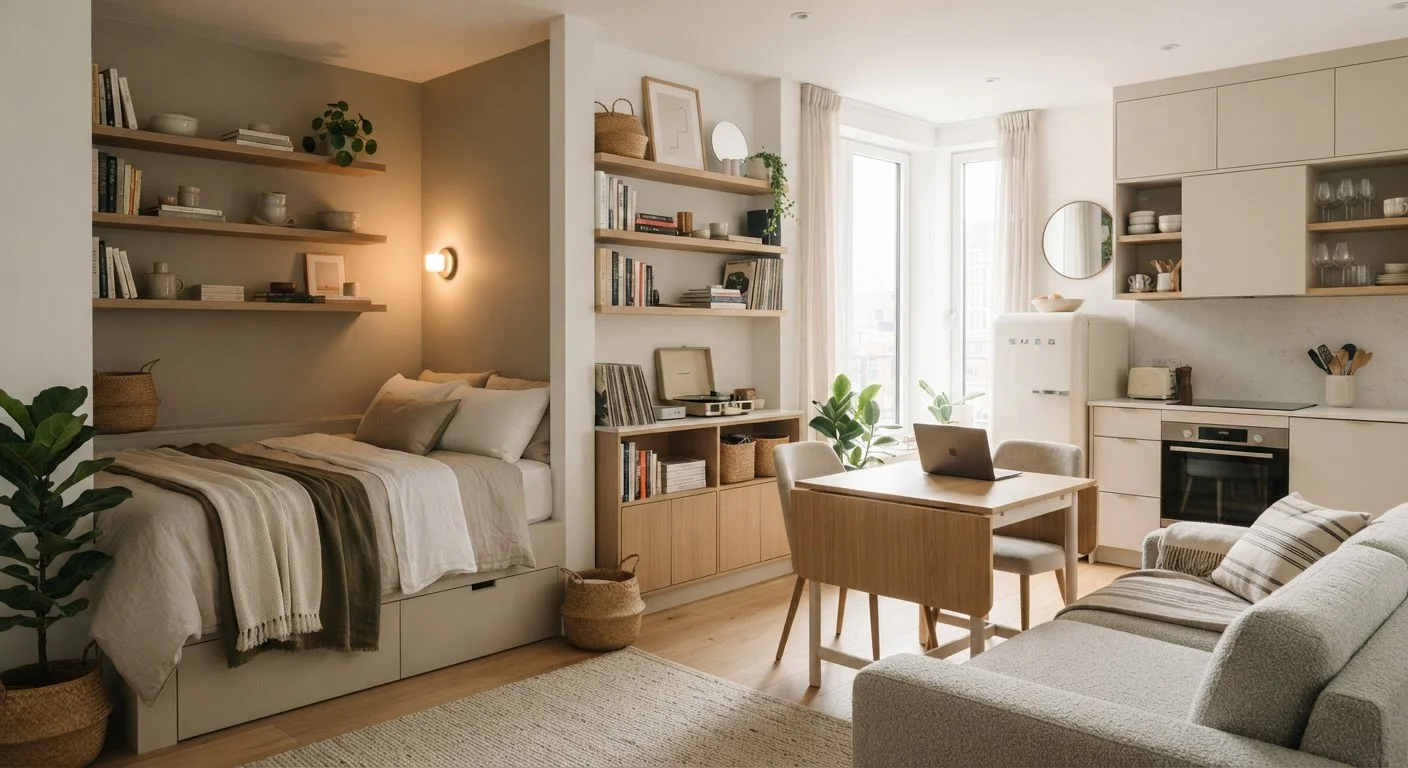
Think of your apartment in functional zones rather than rooms. Even a studio can have a sleep zone, a work zone, and a living zone - each with its own defined storage logic. This approach is explored in more depth in our guide on zone-based vs. category-based organization.
If you share your space with others, the added layer of coordinating habits matters - see strategies for organizing shared spaces for approaches that account for different personal styles.
38%
Americans living in apartments nationally
According to U.S. Census Bureau housing data, roughly 38% of occupied housing units are renter-occupied, with apartments making up a significant share of that total.
~882 sq ft
Average U.S. apartment size
RentCafe analysis of U.S. apartment stock has tracked average unit sizes around 882 square feet, underscoring how common compact living arrangements are.
A calmer, organized environment also tends to support clearer thinking and lower day-to-day stress - something worth keeping in mind if you're also working on your mental wellbeing more broadly.
Small Bathrooms Follow the Same Logic
Compact bathrooms often suffer the same overflow issues as the rest of a small apartment. If your bathroom storage feels maxed out, our guide on small bathroom upgrades covers storage improvements that don't require any major construction.