Why Different Road Users Demand Different Awareness
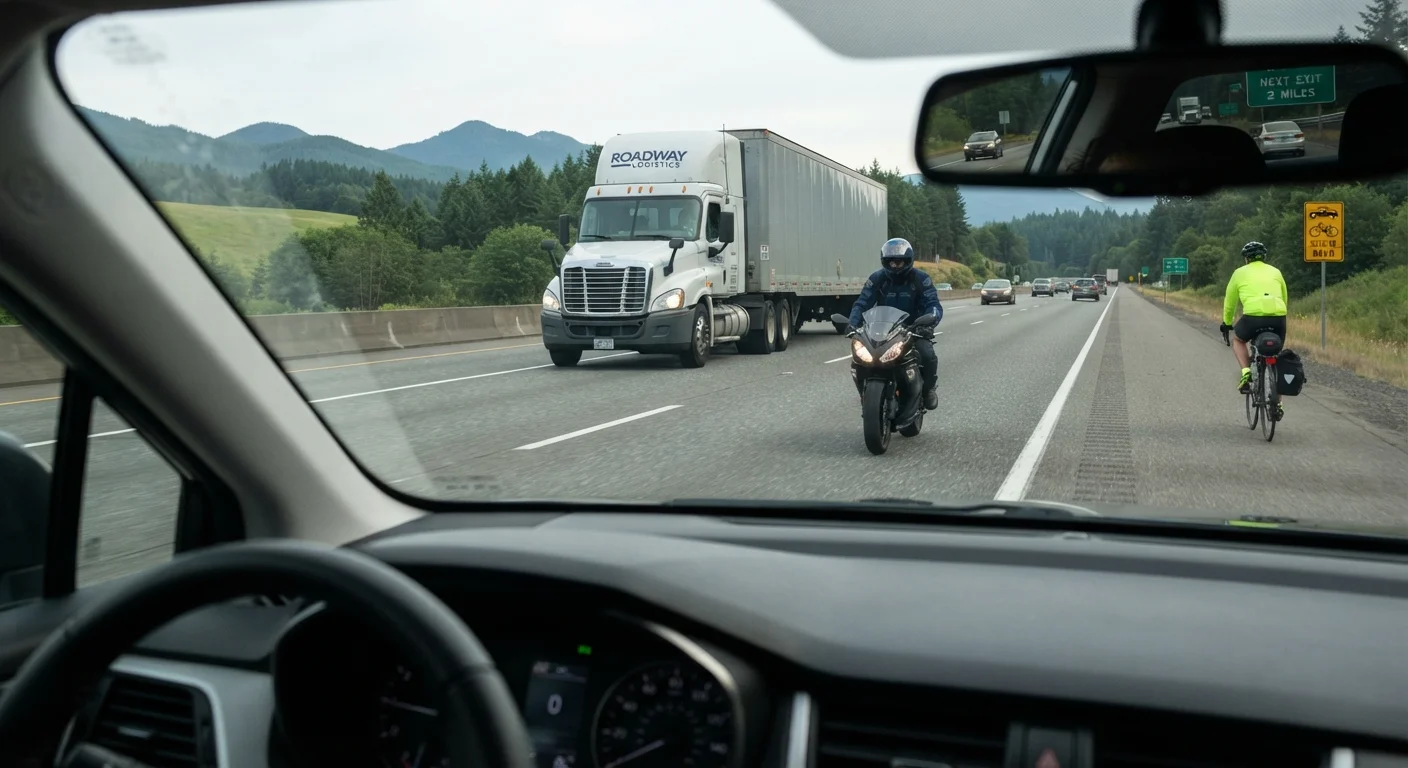
Most drivers are trained to share the road with cars - vehicles roughly the same size, weight, and stopping capability as their own. But American roads routinely mix passenger cars with 80,000-pound semi-trucks, motorcycles weighing under 500 pounds, and cyclists with no metal shell at all. Each combination creates a unique set of hazards that standard car-to-car habits don't address.
Understanding what other road users can and cannot see, how quickly they can stop, and what the law requires of you in their presence is one of the highest-value skills any driver can develop. For a broader foundation, see our guide to defensive driving on American roads.
Sharing the Road With Large Trucks
Commercial trucks - semis, tractor-trailers, box trucks - operate under physics that are simply incompatible with the assumptions most drivers carry from car-only experience.
Blind spots are much larger than you expect. A fully loaded semi has four significant blind zones: directly in front of the cab (up to 20 feet), directly behind the trailer (up to 30 feet), along the driver's left side, and a wide zone spanning multiple lanes on the right. If you can't see the truck's mirrors, the driver almost certainly cannot see you.
Stopping distances are vastly longer. At 65 mph, a loaded semi needs roughly 525 feet to stop - nearly the length of two football fields. Cutting in front of a truck and braking is one of the most dangerous maneuvers a driver can make. Our article on stopping distances and following gaps explains the underlying physics in detail.
Wide turns require space. Large trucks routinely swing left before turning right. Never squeeze between a turning truck and the curb - the trailer's rear wheels cut the corner and will hit anything in that space.
Federal Hours-of-Service Rules Affect Truck Driver Fatigue
Commercial truck drivers are regulated by Federal Motor Carrier Safety Administration (FMCSA) hours-of-service rules that limit consecutive driving time. However, enforcement depends on compliance and roadside inspections. As a practical matter, assume any large truck you encounter on the highway may be driven by a fatigued operator, especially late at night or in early morning hours - and maintain extra following distance and visibility accordingly.
Sharing the Road With Motorcyclists
Motorcyclists are entitled to the full width of their lane under the laws of every U.S. state. They are not required to ride to the edge, and they frequently adjust their lane position deliberately - to stay out of blind spots, avoid road debris, or maintain visibility to following traffic. Never interpret a motorcyclist riding in the center or left third of a lane as an invitation to squeeze past them.
They're harder to see and easier to misjudge. A motorcycle's narrow profile makes it genuinely difficult to judge its speed and distance, especially at intersections. Studies by the National Highway Traffic Safety Administration (NHTSA) consistently identify left-turn crashes - where a driver fails to yield to an oncoming motorcycle - as a leading cause of fatal motorcycle collisions.
Following distance matters more, not less. A motorcyclist can stop faster than most cars on dry pavement. Maintain at least a three-to-four-second gap when following a motorcycle, and account for the fact that road debris or pavement changes that a car would absorb can cause a motorcyclist to brake or swerve suddenly.
Use the 'SMIDSY' Check at Intersections
"Sorry, mate, I didn't see you" (SMIDSY) is a term used in road safety training to describe the most common driver explanation after striking a motorcyclist. Before proceeding at an intersection, make a deliberate second look specifically for motorcycles - not just a general scan. Their narrow profile means they can disappear in the same visual space a car would fill, especially against a busy background.
Sharing the Road With Cyclists
In all 50 states, bicyclists operating on public roads have the same legal rights and responsibilities as motor vehicle operators. They are required to follow traffic signals, stop signs, and lane markings - and drivers are required to treat them accordingly.
Passing distance laws are now standard in most states. The majority of U.S. states have enacted minimum passing distance laws requiring drivers to leave at least three feet of clearance when overtaking a cyclist. Some states mandate more. If traffic or road width makes a safe pass impossible, wait for a clear opportunity rather than squeezing through.
Watch for cyclists at intersections and driveways. Cyclists travel faster than pedestrians, and drivers cutting across a bike lane - whether turning or entering from a driveway - frequently misjudge their speed. Always check for cyclists before turning right across a bike lane.
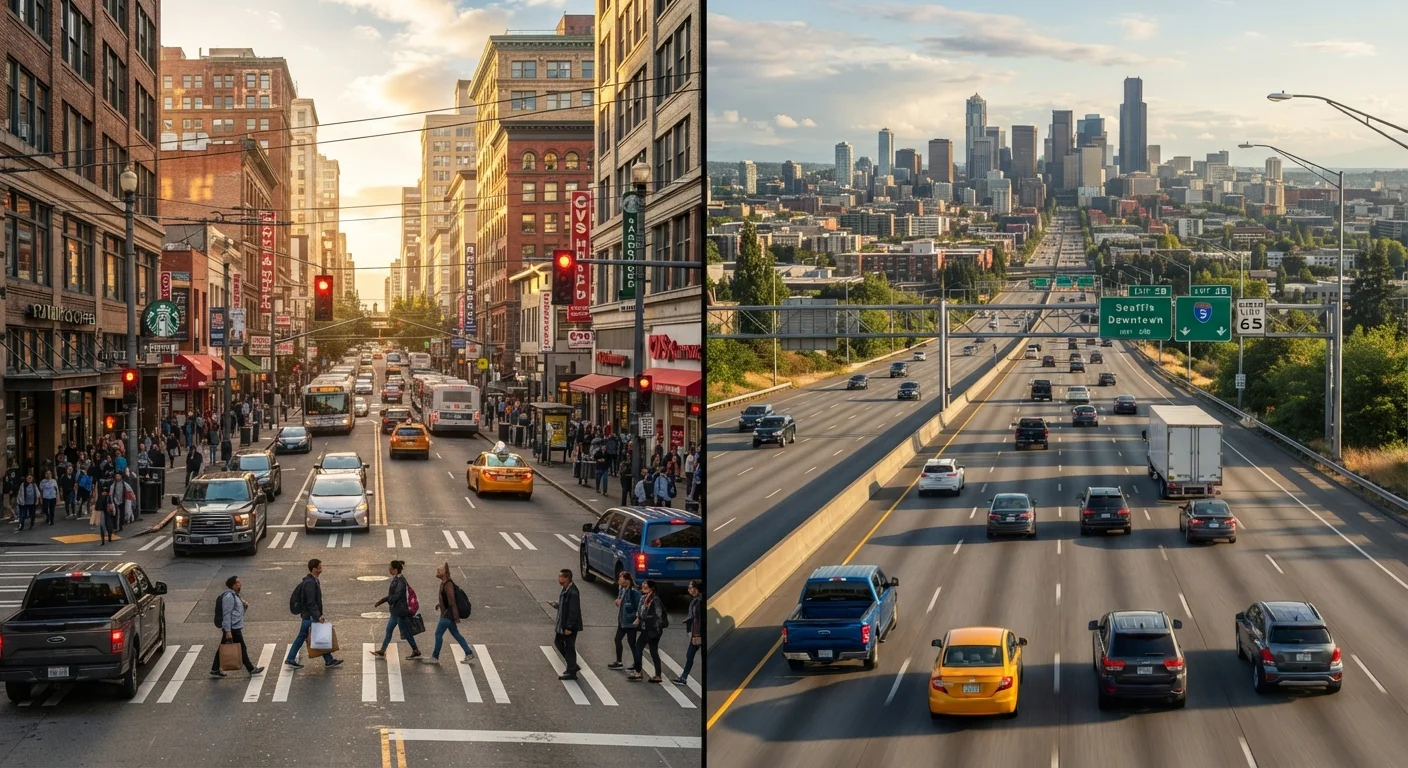
Door-zone awareness prevents serious injury. When parking on street, look for approaching cyclists before opening your door. A cyclist struck by an opening car door - a collision called a "dooring" - can be thrown into traffic. For a full look at how road environment shapes your responsibilities, see our comparison of highway and city driving demands.
Building Consistent Mixed-Traffic Habits
Safe driving around trucks, motorcycles, and cyclists doesn't require a different mindset for each - it requires one consistent habit: anticipate limitations, not just rules. Ask what the other road user can't see, can't stop quickly enough to avoid, or is most vulnerable to, and position yourself accordingly.
Check your mirrors for motorcycles and cyclists before every lane change. Give trucks extra following distance and extra time to complete turns. Never pass any vulnerable road user when oncoming traffic, narrow lanes, or poor visibility makes the maneuver unsafe, even if the law technically permits it. Traffic laws set minimums - safe driving asks more than that.
For drivers who want to build these habits systematically, our article on U.S. traffic laws every driver should know covers the legal framework that applies to all road users.
~525 ft
Stopping distance for a loaded semi at 65 mph
Federal Motor Carrier Safety Administration guidelines note that stopping distances for fully loaded commercial trucks are dramatically longer than for passenger vehicles at highway speeds.
29x
Higher fatality rate per mile for motorcyclists vs. car occupants
According to NHTSA data, motorcyclists are approximately 29 times more likely than passenger car occupants to die in a crash per vehicle mile traveled.
3 feet
Minimum legal passing clearance for cyclists in most U.S. states
The majority of U.S. states have enacted three-foot minimum passing distance laws for motor vehicles overtaking bicyclists on public roads.