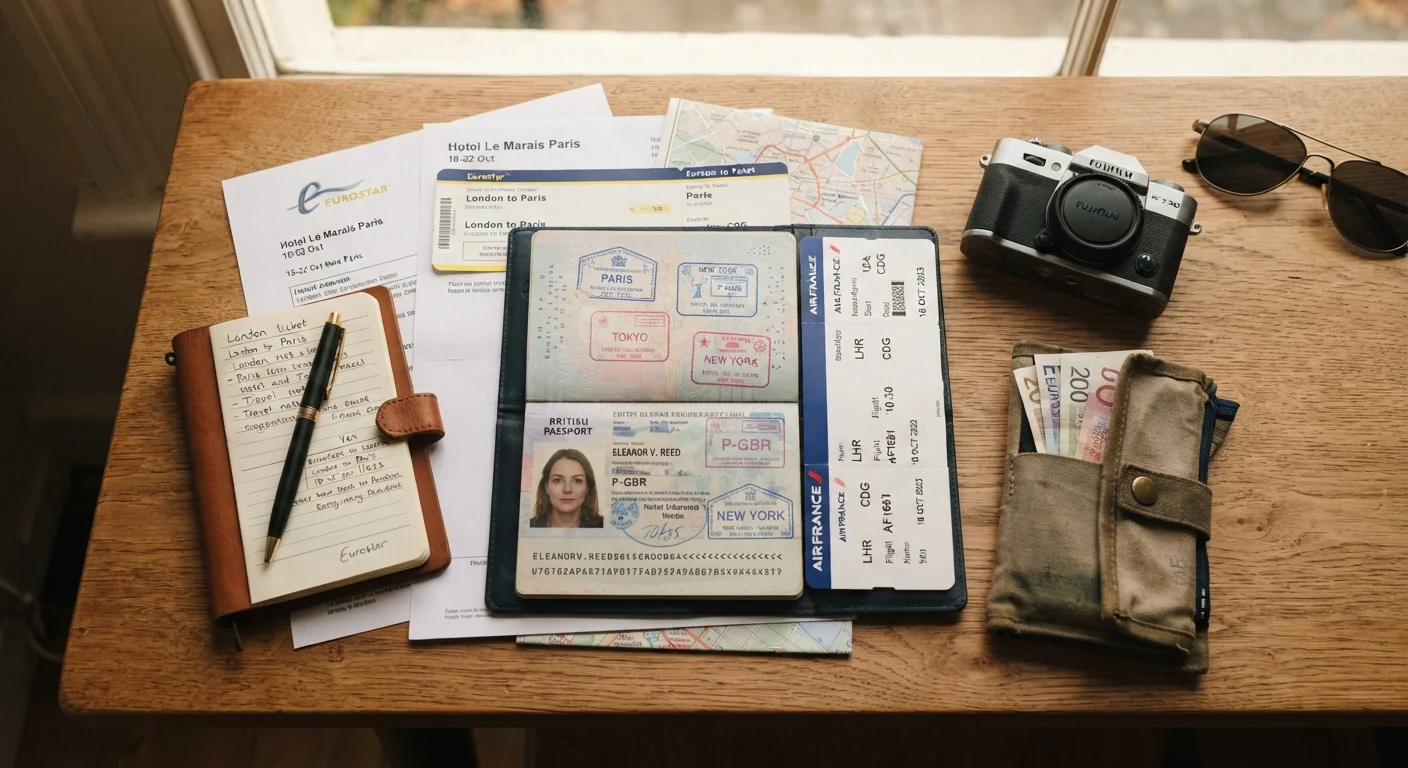

Passports, Visas, and Entry Documents
Every international trip begins with one non-negotiable item: a valid U.S. passport. Most countries require that your passport remain valid for at least six months beyond your intended departure date - not just your arrival. If yours is expiring soon, renew early, as processing times can stretch several weeks or longer depending on demand. For a deeper breakdown of what to prepare before you ever reach the airport, see our first-time international travel guide.
Beyond the passport, many destinations require a visa - an official government authorization permitting entry. Visa requirements vary by country and by the purpose of your visit (tourism, business, transit). Some countries offer visa-free access to U.S. passport holders; others require an application weeks or months in advance. Always verify current requirements directly with the destination country's embassy or consulate and cross-reference with the U.S. Department of State's travel portal before booking.
| Passport Validity Buffer | At least 6 months beyond travel dates (U.S. Department of State guidance) |
| Visa-Free Countries for U.S. Passports | Approximately 186 destinations (Henley Passport Index (figures vary by source and change over time)) |
| STEP Registration | Free; recommended for all international travel (U.S. Department of State) |
| ETA Processing Time | Minutes to several days depending on country (Varies by destination government) |
| Common Vaccination Requirement | Yellow fever proof for select destinations (CDC Travelers' Health portal) |
| Passport Renewal Processing | Routine: 6-8 weeks; Expedited: 2-3 weeks (times vary) (U.S. Department of State (verify current times before applying)) |
A growing number of countries use an Electronic Travel Authorization (ETA) - a lightweight pre-approval that is faster than a full visa but still mandatory. Examples include Canada's eTA and Australia's ETA. These are typically applied for online and approved within minutes to days, but never assume approval is automatic.
Health Documentation and Vaccination Requirements
Health documentation has become a standard part of international travel logistics. Some countries require proof of specific vaccinations - yellow fever being one of the most common - as a condition of entry, especially if you're arriving from a country where the disease is endemic. The Centers for Disease Control and Prevention (CDC) maintains country-by-country health notices that are worth consulting well before your departure date.
Health Requirements Change - Always Verify Officially
Vaccination and health documentation requirements are set by individual governments and can change with little notice. What was true for a destination last year may not apply today. Always check the CDC's Travelers' Health portal and the destination country's official entry requirements within 30 days of your travel date. This article provides general educational information, not personalized medical or travel health advice.
Travelers with underlying health conditions, those who are pregnant, or those traveling with young children should consult a qualified healthcare provider or travel medicine specialist before departure. General travel health information is educational, not a substitute for personalized medical guidance.
Carry physical or digital copies of any required health documents. A travel health card or vaccination booklet (sometimes called a "yellow card" for yellow fever) may be inspected at border crossings. For a full rundown of which documents to keep on hand during your trip, see our complete document checklist.
Currency, Finances, and Money Logistics
Understanding how money works at your destination is as important as knowing how to get through customs. Most countries have their own currency, and exchange rates fluctuate daily. Research whether your destination is largely cash-based or card-friendly - this varies significantly between regions and even between cities and rural areas within the same country.
Notify your bank and credit card issuers before you travel to prevent international transactions from being flagged as fraudulent. Look into whether your card charges foreign transaction fees; many travel-oriented cards do not, but standard consumer cards often do. ATMs abroad typically offer competitive exchange rates, though fees can add up. Carry a modest amount of local currency for arrival - taxis, tips, and small vendors may not accept cards.
~186
Countries accessible visa-free or visa-on-arrival for U.S. passport holders
According to the Henley Passport Index; exact figures shift as bilateral agreements change.
6 months
Minimum passport validity required by many countries beyond your travel dates
Enforced at check-in by airlines and at border crossings; travelers who don't meet it risk denial of boarding.
1-3%
Typical foreign transaction fee on standard consumer credit cards
General industry range; fee structures vary by issuer and card type.
For travelers comparing the planning demands of an international trip versus a domestic one, our domestic travel planning resource illustrates how the logistics differ at every stage.
Final Checks Before You Depart
A few days before departure, run through a structured review of everything that could affect your trip. Confirm that your bookings - flights, accommodations, any required transfers - match your passport name exactly. Double-check visa validity windows; some visas specify not just the entry date but how long you may stay once inside the country.
Register your trip with the U.S. Department of State's Smart Traveler Enrollment Program (STEP). This free service connects you with the nearest U.S. embassy or consulate in case of emergencies and ensures you receive updated travel advisories for your destination. Store emergency contact numbers - including the local U.S. embassy - separately from your phone in case of loss or theft.
Use our pre-trip checklist to walk through documents, bookings, home preparation, and health items systematically. For a comprehensive end-to-end logistics reference, our complete international planning reference covers everything from passport validity rules to re-entry customs declarations.
Visa
An official authorization issued by a foreign government that permits a traveler to enter, transit, or remain in that country for a specified purpose and duration. Requirements vary by nationality and destination.
Electronic Travel Authorization (ETA)
A digital pre-approval system used by some countries that allows eligible travelers to enter without a traditional visa stamp. Applications are submitted online and linked electronically to the traveler's passport.
Six-Month Passport Validity Rule
A requirement enforced by many countries that a visitor's passport must not expire within six months of the planned entry date. Travelers who don't meet this threshold may be denied boarding or entry.
Smart Traveler Enrollment Program (STEP)
A free U.S. government service that registers American citizens' trips with the nearest embassy or consulate abroad. It enables emergency notifications and facilitates contact if a crisis occurs at the destination.
Foreign Transaction Fee
A fee charged by some banks or credit card issuers when a purchase is made in a foreign currency or processed by an overseas financial institution. Fees typically range from 1-3% of the transaction.
Yellow Card (ICVP)
The International Certificate of Vaccination or Prophylaxis - a World Health Organization document that records required vaccinations. Some countries demand its presentation at the border as proof of immunization.